The combat-training classroom smelled like dust, coffee, and wet canvas.
Forty-two recruits sat behind narrow desks while rain struck the high windows of Building 17.
At the front of the room stood COLONEL GRACE MILLER.
Forty-six.
Five feet six.
Dark hair pulled tightly behind her head.
No dramatic voice.
No habit of shouting.
She didn’t need either.
Two silver eagles sat on her uniform.
A combat patch rested on one shoulder.
Rows of ribbons covered the left side of her chest.
But she rarely discussed any of them.
Today’s lesson was written across the board in large black letters.
LEAVE NO ONE BEHIND.
Grace faced the recruits.
“You will hear that sentence so often that eventually it stops sounding like a promise.”
Nobody moved.
“It becomes a slogan.”
She walked slowly between the front desks.
“That’s dangerous.”
A recruit near the third row raised his hand.
“Why, ma’am?”
“Because slogans are easy.”
Grace looked across the room.
“Carrying another human being when you’re exhausted isn’t.”
A few recruits shifted.
“Turning around when every instinct tells you to keep moving isn’t.”
She stopped.
“And accepting that sometimes you cannot save everyone is harder than both.”
Silence.
Then a voice from the back:
“Easy to say from behind a desk.”
A few recruits smiled.
Grace stopped.
She knew the voice.
PRIVATE OWEN CARTER.
Twenty-two.
Athletic.
Confident.
Former college linebacker.
Strong enough that instructors had already started talking about leadership potential.
Also arrogant enough that those same instructors were beginning to reconsider.
Grace turned.
“Stand up.”
Owen did.
“Say it again.”
Owen looked around.
Several recruits watched him with quiet anticipation.
He lifted his chin.
“You heard me.”
Grace walked toward him.
She stopped several feet away.
“Humor me.”
Owen shrugged.
“It’s easy to tell people nobody gets left behind when you’re standing in a classroom.”
No one smiled now.
Grace asked:
“And where do you believe I should be standing?”
Owen answered:
“Where we are.”
“Which is?”
“Training to go outside the wire.”
Grace looked at the colonel insignia on her own chest.
Then back at him.
“You understand that officers occasionally leave classrooms?”
A few recruits suppressed smiles.
Owen didn’t.
“People like you teach war.”
He stepped closer.
“People like us fight it.”
The room changed.
SERGEANT FIRST CLASS RAYMOND BISHOP, the senior drill instructor standing beside the door, started forward.
Grace raised one hand.
He stopped.
Grace looked at Owen.
“Finished?”
Owen should have said yes.
Instead he stepped around her.
Grace turned away.
Maybe he thought she’d dismissed him.
Maybe he wanted the last word.
Maybe pride simply becomes stupidity when it gets enough witnesses.
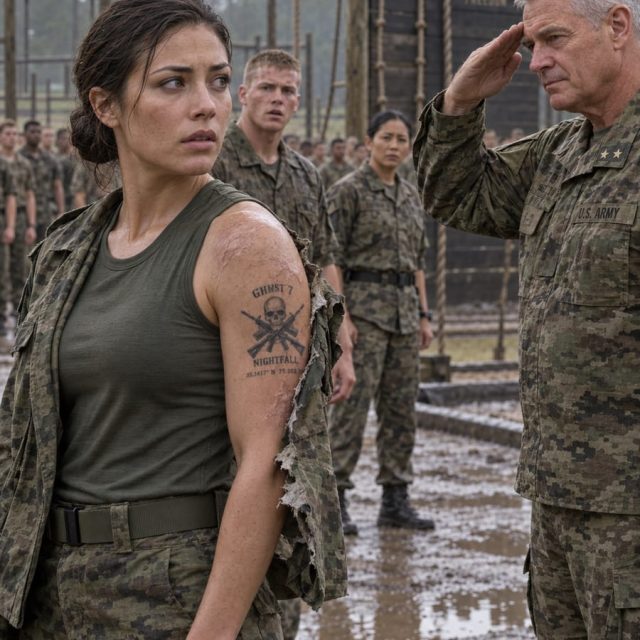
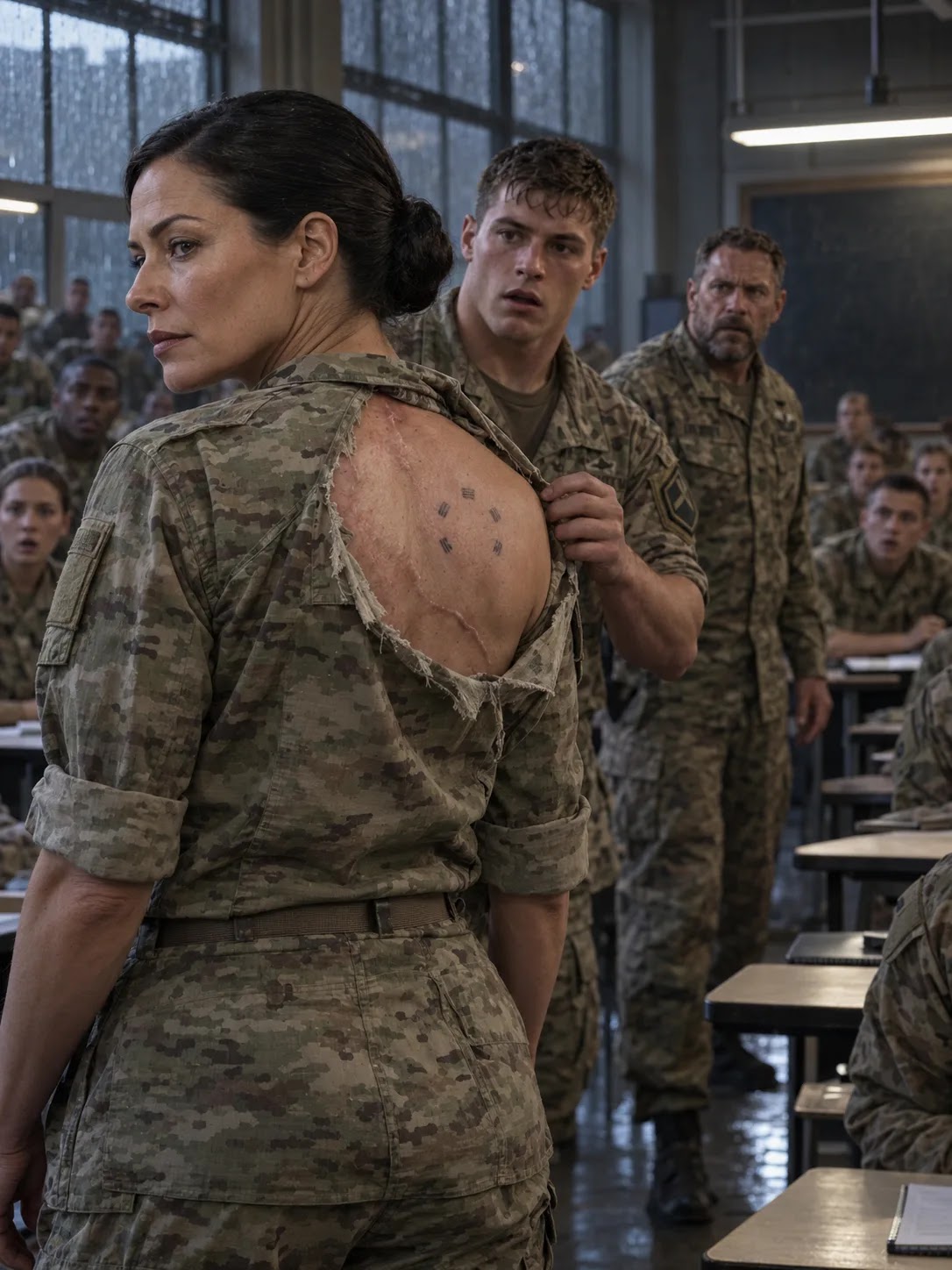
Owen grabbed the back of Grace’s uniform shirt.
“Don’t turn your back when I’m—”
The fabric tore.
A sharp ripping sound crossed the room.
Everyone froze.
Grace did too.
The tear opened across her left shoulder blade.
Underneath was scarred skin.
And black ink.
Six small military identification numbers formed a rough circle.
Between them sat one empty space.
Nothing written there.
No number.
No name.
Just bare scar tissue.
Owen stared.
His hand remained wrapped in the torn fabric.
Grace’s voice changed.
“Let go.”
He did.
Immediately.
Bishop had crossed half the room before he saw the tattoo.
Then he stopped.
His face went pale.
“Ma’am.”
Grace didn’t turn.
Bishop stared at the six numbers.
He knew them.
Not individually.
As a group.
Every senior infantry instructor did.
They belonged to the survivors of CHARLIE PLATOON, Third Battalion.
Operation Crosswind.
The Marah Valley.
Twelve years earlier.
Bishop’s voice became quieter.
“Your platoon?”
Grace nodded once.
“Six came home.”
Owen looked at the tattoo again.
Six identification numbers.
One empty position.
He swallowed.
“What does the blank one mean?”
Grace finally turned.
Her face was completely still.
“Me.”
Owen frowned.
“I don’t understand.”
Grace looked at him.
“I wasn’t supposed to.”
No one spoke.
The rain against the windows became the loudest sound in the room.
Owen’s eyes moved toward the scars crossing Grace’s shoulder.
He had thought the colonel behind the desk had never been where he was going.
He had been wrong.
Very wrong.
Bishop stepped forward.
“Colonel, do you want the room cleared?”
“No.”
Grace pulled the torn fabric together.
Then looked at Owen.
“Sit.”
He obeyed.
Grace returned to the front of the classroom.
She picked up the marker.
Her hand trembled once.
Barely.
She put it down.
Then faced the recruits.
“Since Private Carter has decided today’s lesson requires context…”
Nobody moved.
Grace looked toward the words on the board.
LEAVE NO ONE BEHIND.
“Twelve years ago, I believed I understood that sentence too.”
She paused.
“I didn’t.”
Operation Crosswind began with thirty-two soldiers.
Grace was then CAPTAIN GRACE MILLER.
Twenty-four hours later, Charlie Platoon had been reduced to seven people capable of moving.
Grace and six soldiers.
Bishop knew the public version.
Most of the Army did.
The platoon had been trapped after a routine support mission collapsed into a coordinated attack.
Communications failed.
Their vehicles were destroyed.
Bad weather grounded aircraft.
The seven remaining soldiers crossed eleven miles of hostile terrain to reach an evacuation point.
Six arrived.
Grace Miller did not.
She was declared missing.
Then presumed dead.
Nine days later she walked into an allied checkpoint forty-three miles away.
Alone.
Dehydrated.
Burned.
Shot.
Carrying the identification tags of three soldiers who hadn’t survived.
The Army called it extraordinary.
Grace called it the worst nine days of her life.
Owen stared at the blank space on her back.
Grace could see the question on his face.
She answered before he asked.
“The six numbers belong to the soldiers I got onto the evacuation helicopter.”
She pointed toward the empty place.
“That was supposed to be my number.”
A recruit whispered:
“Why isn’t it there?”
Grace looked at him.
“Because they tattooed it before they knew I was alive.”
Silence.
“The medic who designed it left a space for me.”
She looked toward the window.
“The others refused to fill it after I came back.”
Owen finally spoke.
“Why?”
Grace met his eyes.
“Because they said I hadn’t earned a memorial while I was still breathing.”
Something about the sentence unsettled him.
Grace turned back toward the board.
“Now.”
She pointed to the words.
“Let’s try this lesson again.”
Class ended at 1100.
Nobody rushed out.
Owen remained at his desk.
Grace gathered her notes.
Eventually the room emptied.
Except for Owen.
And Bishop.
Grace said:
“Sergeant Bishop.”
“Ma’am.”
“Give us a minute.”
Bishop looked at Owen.
He clearly preferred giving him something else.
But he left.
Grace continued packing.
Owen stood.
“Ma’am.”
Nothing.
“I’m sorry.”
Grace closed the folder.
“For tearing my uniform?”
“Yes.”
“Good.”
He waited.
“And for what I said.”
Grace looked at him.
“Why?”
Owen seemed confused.
“Because I was wrong.”
“About me.”
“Yes.”
Grace shook her head.
“Try again.”
He frowned.
She walked toward him.
“You believed disrespect was acceptable because you thought I hadn’t fought.”
Owen said nothing.
“Then you saw a tattoo, and suddenly I became worthy of an apology.”
His face changed.
Grace continued.
“That’s the wrong lesson.”
Owen looked down.
“I understand.”
“No, you don’t.”
Her voice remained calm.
“Not yet.”
She picked up the torn section of her shirt.
“You don’t owe people respect because they have scars.”
Another step.
“You owe them respect before you know where the scars are.”
Owen nodded.
This time more slowly.
Grace headed toward the door.
He called after her.
“Colonel.”
She stopped.
“What happened after the helicopter?”
Grace’s face changed.
The question carried her twelve years backward.
She answered:
“I made a promise.”
“What promise?”
Grace looked toward the six numbers hidden beneath her uniform.
“That if I got the others home, I’d go back for the last man.”
Owen frowned.
“But you said six came home.”
Grace nodded.
“I didn’t say everybody did.”
Then she left.
For the rest of the day, Owen couldn’t stop thinking about the empty space.
Or the man who apparently wasn’t included in it.