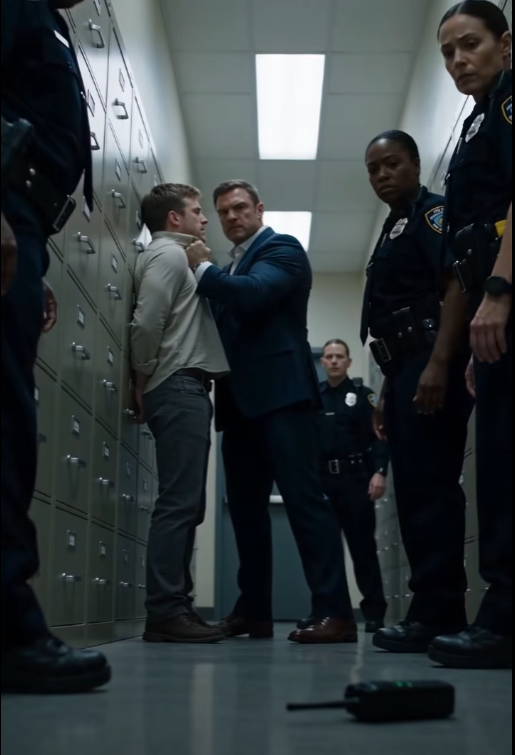
The witness had not wanted to become part of the investigation. He had been a night maintenance worker in a government building, accustomed to staying invisible while officials argued over cases and deadlines. One evening, while repairing a damaged ceiling panel, he found a small recording device hidden above a records corridor. The device contained a conversation that suggested evidence had been removed from a closed investigation.
He reported the discovery to an investigator who was known for following procedure rather than chasing attention. She asked him to preserve the device and avoid discussing it with anyone else. The witness agreed, but the building’s senior detective learned that he had spoken to her.
The detective had controlled the corridor for years. Younger officers admired his arrest record and assumed his confidence meant competence. He had a way of making uncertainty look like guilt. When the witness arrived for a formal statement, the detective positioned himself beside the locked archive door and told everyone that the maintenance worker was trying to create a scandal.
The investigator was delayed by a hearing, leaving the witness alone with the detective and two junior officers. The detective asked where the recording was. The witness said it had already been secured. That answer changed the detective’s expression.
He grabbed the witness by the collar and struck his upper chest with a heavy punch. The witness hit the door and struggled to breathe. The detective shouted, “Stop talking!” One junior officer moved forward, then stopped when the detective glared at him. The witness kept his hands visible and refused to fight back.
The detective accused him of stealing confidential property. He demanded the recording and claimed that the investigator would never believe a maintenance worker over a decorated officer. The witness looked toward the security camera above the exit, but the detective followed his gaze and smiled. He believed the camera had been disconnected for repairs.
The investigator arrived before he realized the hallway microphone was still active. She saw the detective strike the witness’s shoulder and immediately stepped between them. The impact of her movement made a radio fall against the tile. Every sound in the corridor seemed to disappear.
She placed her phone on the floor and said, “The hallway camera heard you.”
The phone began playing a synchronized feed from the corridor system. The image showed the detective demanding the recording, threatening the witness, and admitting that he had removed evidence from the old case. The audio captured his voice clearly. The junior officers watched without speaking.
The detective insisted the footage had been fabricated. The investigator did not argue. She asked one junior officer to secure the corridor and another to call the independent review unit. For the first time, the detective’s authority failed to move anyone.
The witness was taken to a medical room for evaluation, but his injuries were minor. He gave his statement again, this time with the investigator present. The hidden device was entered into evidence, and the old investigation was reopened. Several people who had been convicted were offered new hearings after the missing records were located in a private storage cabinet connected to the detective.
The detective was suspended and later charged through a formal process. The investigator faced pressure from colleagues who believed exposing him damaged the department’s reputation. She answered that reputation built on silence was only concealment.
The witness returned to work for a short time, but he no longer repaired the same building. He accepted a position maintaining security systems for a public archive, where his knowledge was valued rather than ignored. He kept the phone recording on his desk as a reminder that technology had not saved him by itself. Someone had to choose to use the evidence.
The junior officers who had hesitated eventually testified. Their decision did not erase the moment they stood still, but it prevented the same silence from protecting the detective again. In the corridor where the witness had been attacked, a new camera was installed at eye level. It did not point down from a corner. It faced the people who believed nobody was watching.