Mara Cole slapped her palm against the passenger window of the black Chevrolet Tahoe as it roared past the line of motorcycles. For a fleeting moment, her twelve-year-old face appeared behind the tinted glass—rainwater streaking her dark hair, her gaze locking onto Wade Mercer, as if out of everyone on the highway, she’d chosen him.
Her hands moved in a blur.
DON’T SAVE ME.
She pointed emphatically over her shoulder, toward the rear cargo area.
The Tahoe surged forward in the rain.
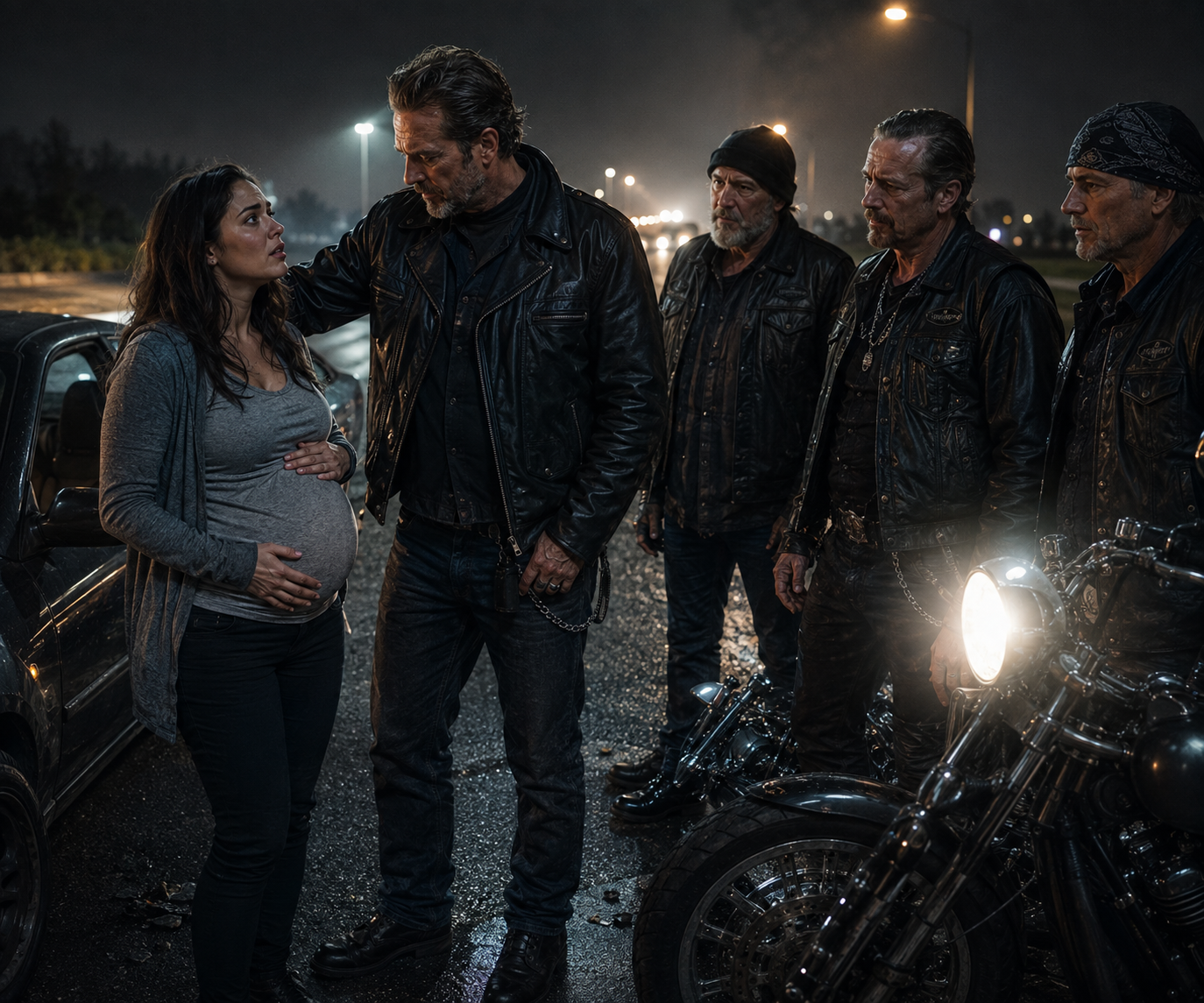
Wade’s Harley vibrated beneath him, thunderous and alive. Around him, sixteen members of the Iron Harbor club cut through the wet Albuquerque evening in a precise formation, leather jackets growing even darker from the monsoon’s first downpour. Their headlights bled across the reflective street as the scent of creosote, exhaust, and far-off lightning drifted up from the steaming pavement.
For an instant, Wade questioned if he really understood her message.
Then, Mara turned in her seat, pounding the glass once more.
The driver’s head snapped in her direction.
The Tahoe veered across two lanes without a turn signal.
Wade dipped his head closer to the mic inside his helmet.
“Black Tahoe. New Mexico plate Seven-Kilo-Romeo-Four-Nine-Two. Nobody crowds him.”
Static buzzed in his ear.
From three bikes behind, Tessa Collins replied first. “You see a weapon?”
“No.”
“Girl in danger?”
“I don’t know.”
It was true, and Wade despised that reality.
His American Sign Language was more than passable. He’d learned it for his niece June, born Deaf, determined that she’d never have to work harder to communicate with him. He recognized help, afraid, hurt, father, police—all the basics.
But never before had he seen a terrified child sign Don’t save me.
The Tahoe sped for the cluster of evening traffic near Central Avenue, its brakes flaring red through the storm. Wade fought the urge to chase—he knew too well that pursuit only made scared drivers dangerous, and dangerous meant kids got hurt.
“Keep distance,” he muttered. “Cameras on.”
Sixteen gloved thumbs toggled helmet controls.
Small red lights blinked on above sixteen visors. The club’s cloud system began archiving every perspective—the Tahoe, the riders, Mara’s face at the window. Iron Harbor understood that what people saw could become evidence long before facts could catch up. The image of bikers encircling a family SUV could be twisted into any accusation.
Tonight, they’d guard the truth themselves.
Tessa pulled onto the shoulder, calmly calling 911 through her helmet’s comms.
“Possible child in distress. We are not pursuing aggressively. We are maintaining visual contact.”
Up ahead, the stoplight glowed red.
The Tahoe rolled to a halt at the intersection.
Cars lined up on all sides, wipers in sync. Rainwater pooled neon from a nearby tire shop. A city bus hissed to a stop beside them, its crowded interior casting yellow light through foggy windows.
Wade coasted even with the Tahoe, leaving a deliberate six feet between his bike and the passenger side.
Mara sat taut against her seatbelt, clad in a gray sweatshirt with a silver moon on the front. One sleeve was stretched at the wrist, as if someone had yanked her hard. Her breath fogged a spot on the window.
The man at the wheel looked nothing like a villain.
Late thirties, clean-shaven, brown hair neatly parted, a pale blue shirt buttoned crisp. Silver wedding band glinting on his right hand as he gripped the wheel. His face held the weary irritation of a father tired of being bothered by strangers.
He cracked the window three inches.
“What the hell do you want?”
Wade flipped up his visor. Raindrops gathered on the bridge of his broad nose, running into the gray of his beard.
“Your daughter tried to tell me something.”
“She’s Deaf.”
“I know.”
The driver’s jaw tightened, his expression shifting almost imperceptibly.
Mara met Wade’s eyes.
Her right hand slipped below the window level.
Three dull knocks thudded from inside the Tahoe.
Tap. Tap. Tap.
Wade listened, holding his breath.
From behind the second row, another set of softer knocks answered.
The man turned up the radio’s volume.
Country music vibrated the glass, filling the vehicle with noise.
Wade’s pulse hammered.
“Turn that down,” he pressed.
The driver let out a short, skeptical laugh. “You don’t give orders to my family.”
He lifted his phone, already recording.
“Look at this,” he stated, camera pointed. “Biker gang surrounding a father and his disabled child.”
Two Iron Harbor riders had stopped behind the Tahoe, keeping their distance, while three others held in adjacent lanes, careful not to obstruct traffic. No one touched the SUV or shouted. Their bikes idled with the deep, measured rumble of patient beasts.
The driver angled his phone to catch the iron lighthouse on Wade’s vest, the battered leather, scars trailing from Wade’s knuckles up his sleeves.
He raised his voice.
“My name is Daniel Cole. This is my daughter, Mara Cole. I have legal custody documentation in the vehicle. These people are threatening us.”
Mara’s attention darted to the rearview mirror.
Tap. Tap. Tap.
The faint reply sounded from behind.
Wade saw Daniel’s thumb stab the steering-wheel volume until the music swallowed the noise.
Tessa’s voice cut through Wade’s helmet speakers.
“Dispatch sent me a secure video link. Patching my camera now.”
“Send all feeds.”
“Doing it.”
Soon, sixteen helmet cameras broadcasted directly to emergency dispatch. In some control room, a dispatcher now witnessed what the bikers saw: Daniel filming, Mara’s drained face, rain crawling over black metal.
The light stayed red.
Daniel reached into the glovebox. Wade tensed, but he only drew out a thick plastic folder.
“Here,” Daniel said.
He pressed a birth certificate against the window slit.
The name was clear.
Mara Elise Cole.
Father: Daniel James Cole.
He followed with family photos: Mara at six on Daniel’s shoulders beneath fireworks, Mara at eight with a cake, Mara asleep on his chest. In each, Daniel appeared gentle and unremarkable.
Next came a court document, covered in seals and signatures.
Wade studied them through the rain-smeared glass.
They appeared legitimate.
Daniel caught Wade’s hesitation and pressed his advantage.
“You made a mistake,” he said quietly. “Back away before you traumatize her any more than you already have.”
Mara fixed her stare on Wade.
Her hands were motionless.
Traffic on the cross street began to move. Their own light would turn soon.
Wade felt the pressure of sixteen riders, all waiting for his lead. They trusted him because he didn’t equate authority with aggression. After twenty-three years as an EMT, crawling into disaster after others’ mistakes, he knew how easily confidence could become recklessness.
Maybe, Wade thought, Mara had signed something else. Maybe the rain, the window, and fear twisted the words. Maybe the knocks were nothing but cargo shifting.
Daniel set the paperwork on the dash like a barrier.
“Her mother turns her against me,” he insisted. “She tells Mara to create scenes. This is a custody dispute, not a kidnapping.”
The accusation of kidnapping landed before Wade could form it.
Mara’s eyes flicked to him.
Then to the back of the SUV.
Her fingers moved, down beside her thigh, shielded from Daniel’s view.
NOT ME.
BACK.
Wade’s uncertainty vanished.
He signed back, his hand close to his chest, camouflaging the gesture.
CHILD BACK?
Mara responded with one finger up, then four.
A four-year-old.
Daniel noticed Wade’s hand moving.
He seized Mara’s wrist.
It wasn’t forceful enough for a camera to call it abuse—just a firm hold, pressing her hand to her knee.
“Stop encouraging her.”
Wade’s voice turned cold.
No louder, just hollow.
“Take your hand off her.”
Daniel let Mara go, smiling to his phone.
“You see? Threats.”
The cross street’s yellow light flickered.
Tessa’s voice sharpened in Wade’s speakers.
“Dispatch is checking the plate. State troopers are responding from I-40. Two minutes, maybe less.”
“We may not have two.”
Daniel dropped the Tahoe into drive.
The SUV rocked forward, held by the brake.
Wade peered through the rear glass. The cargo area, shielded by a black cover, showed nothing. No movement, no silhouette.
Then, in the lower corner of the window, condensation bloomed.
A child’s handprint—four small fingers and a thumb—appeared faint, then vanished again.
Wade’s heart plunged.
“Daniel,” he said. “There is a child in the back of your vehicle.”
Daniel’s eyes narrowed.
He let out a laugh.
Almost believable.
“That’s luggage.”
“Luggage doesn’t knock.”
“There’s nobody back there.”
“Open the hatch.”
“No.”
His answers came too fast.
A horn blared behind the bikers. Another followed. Curious drivers peered through their rain-streaked windshields, catching only glimpses of black leather and a halted SUV. Cell phones began to rise in the neighboring cars.
Daniel realized he was being watched.
He visibly relaxed, smoothing his cuff, lowering the radio, voice measured as if explaining to unreasonable people.
“I’m going to drive away now. If any of you follow me, block me, or touch this vehicle, I will press charges. My daughter is a minor. You are frightening her.”
He turned to Mara.
“Tell them you’re fine.”
Mara stayed perfectly still.
Daniel leaned in closer.
“Smile.”
She angled her face to the window.
A faint, practiced smile appeared.
To distant onlookers, it might have seemed obedient.
To Wade, it was the look of someone locking the world out.
Tessa’s next words sharpened the air.
“Dispatch update. Family Visitation Center in Los Lunas reported a child taken during a supervised exchange twenty-six minutes ago. Male, four years old. Eli Brooks. Suspect may be Daniel Cole.”
Daniel’s head jerked toward Tessa, as if he’d heard her through the helmet.
Wade watched the red glow of the traffic light in the Tahoe’s windshield.
Still red.
“Plate confirmation pending,” Tessa continued. “Daniel is Mara’s biological father. Documents may be legitimate. He does not have custody of Eli Brooks.”
The reality fell into place, sharp and brutal.
Daniel was ready for anyone who stopped him.
He could prove Mara was his daughter. He had birthday pictures, legal papers. He could blame her mother, blame the bikers, blame the world for meddling. Every document bought him precious seconds.
And a four-year-old, trapped in a sealed compartment, only had so many seconds left.
Mara had known it.
She hadn’t asked to be rescued because that would let Daniel escape with her brother.
She’d made herself the distraction.
Just twelve, sitting beside the man who’d taken Eli, she’d turned her terror into a beacon aimed at the first adult who might listen.
Daniel pressed down on the accelerator.
The Tahoe’s engine climbed.
“Move,” he announced.
Wade looked to Mara.
Her eyes glistened, but her hands were steady.
He signed a single question.
READY?
She managed the smallest of nods.
The intersection light switched to green.
In the next ten seconds, everything changed.
Mara slammed her palm against the glass.
Her hands flickered in Wade’s headlight.
DON’T SAVE ME.
She pointed behind her.
Three tiny raps sounded from the cargo space.
Tap. Tap. Tap.
Wade thrust one fist into the air.
Sixteen engines went silent in unison.
The abrupt quiet rattled the intersection harder than thunder ever could.
The bikers moved as one.
Boots met pavement. Handlebars spun. Heavy motorcycles created a tightening circle around the Tahoe, never touching, but closing off every possible escape with chrome, bodies, and overlapping beams of light.
Daniel’s foot left the gas.
The rear hatch clicked.
It lifted just two inches.
A dark slit opened.
A child’s bare hand slipped into the rain, fingers stretching for help above the bumper.
Wade leaned down from his motorcycle, catching the tiny hand in his own black-gloved grip.
The hand was heartbreakingly small.
It clung tightly to his finger.
For a breathless moment, the truth was unmistakable at the intersection.
Daniel jammed the Tahoe into reverse.
Luis Ortega dropped his bike stand and moved away, leaving his motorcycle as a barrier behind the Tahoe. Tessa did the same opposite him. No one advanced on Daniel’s door or offered him a target for violence.
They simply eliminated every way out.
Daniel looked at the ring of bikers.
Sixteen helmeted faces—sixteen streaming cameras—stared him down.
He froze.
Wade kept his arm through the small opening.
“I’ve got you,” he called gently into the darkness.
The little hand squeezed tighter.
A sound drifted up from beneath the hatch—soft, barely more than breath.
“Ma’a?”
Mara pressed her hands to the glass.
She broke down.
Eli had spoken her name.
Sirens wailed in the distance, growing louder.
Daniel’s calm shattered at last.
“They were keeping him from me,” he yelled. “They wouldn’t let me see my family. I was bringing them home.”
Wade ignored him.
“Eli,” he said quietly. “My name is Wade. I’m right here. Don’t pull on the hatch. Help is coming to open it safely.”
The boy whimpered.
The rain intensified, crashing down on helmets and the Tahoe, cooling metal and soaking leather. Water dripped from Wade’s glove to Eli’s pale knuckles.
Mara started tapping the glass again.
This time, the rhythm was different—slower, steady.
One, two.
One, two.
From the darkness, Eli’s fingers responded against Wade’s glove.
One, two.
One, two.
The first state trooper arrived, lights strobing red and blue over the slick street. Two cruisers and an ambulance pulled in. Officers emerged, holsters closed but hands poised, taking in the scene: the Tahoe at the center, motorcycles arrayed around it, and everything recorded.
Tessa raised her hands in surrender.
“Live feed is ours,” she called. “Driver is Daniel Cole. Missing child is in the rear compartment. No weapons observed.”
Daniel opened his door before the officers reached him.
“I’m the father,” he insisted. “These people trapped us. Look at my paperwork.”
“Hands where we can see them.”
“You don’t understand.”
“Hands. Now.”
Now, for the first time, Daniel seemed diminished.
He raised his hands.
No biker laid a finger on him.
No blows were exchanged.
No one gave Daniel the violence he seemed to crave as justification.
Two troopers cuffed him and led him from the Tahoe, while another officer opened the passenger side. Mara shrank back until the officer signed her name and gestured to Wade.
Wade accompanied the paramedics to the rear. The emergency release had snagged on a blanket, creating the narrow gap through which Eli’s hand reached. The responders stabilized the hatch, cut a nylon strap, and lifted it open.
A rush of overheated, stale air escaped.
Eli lay curled beneath the cover, dinosaur pajamas clinging to his skin, cheeks flushed, blond hair matted with sweat. He wore only one sneaker, and a thin plastic bracelet from the visitation center circled his wrist.
His eyes fluttered open in the light.
He was awake.
Wade almost collapsed with relief.
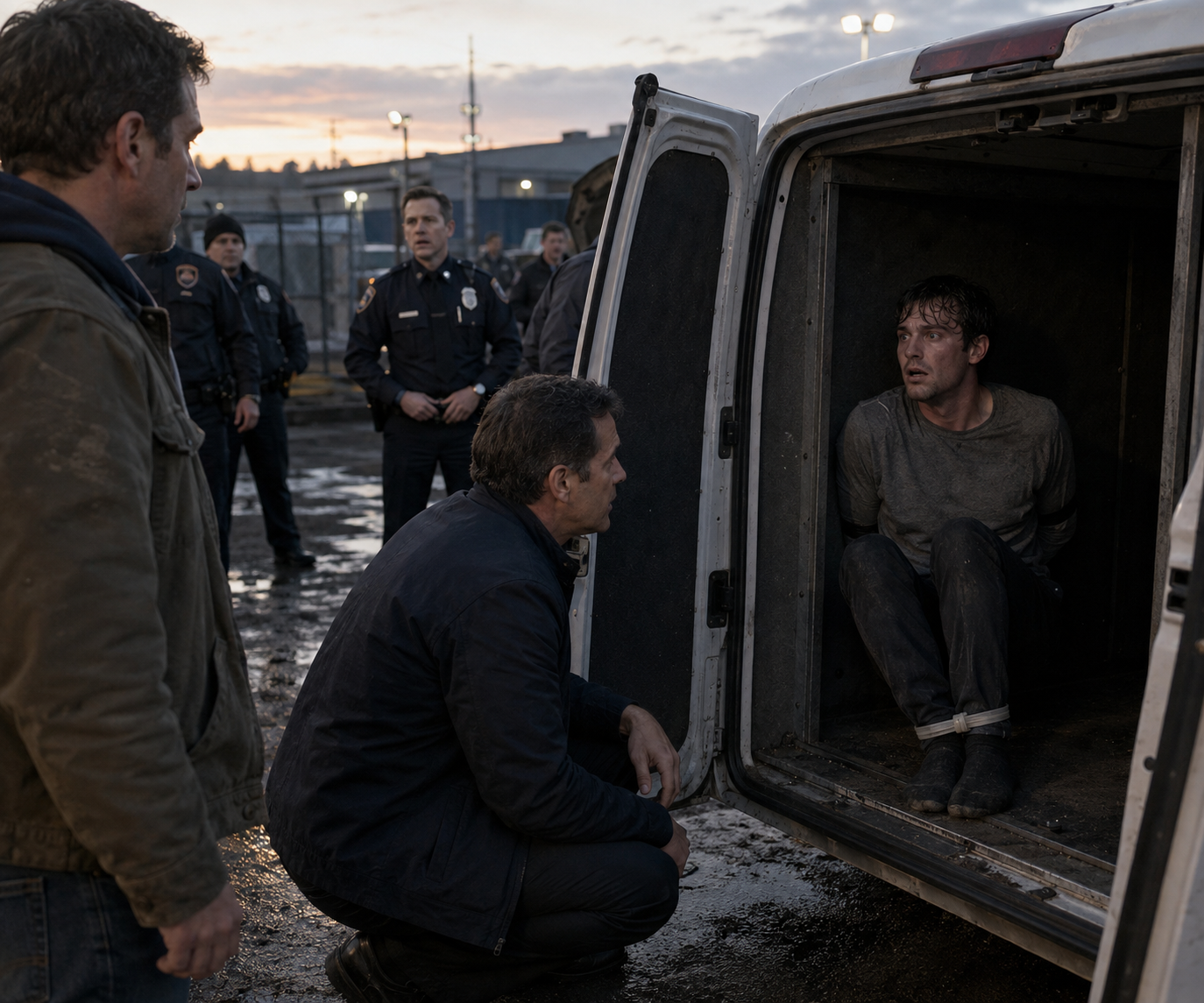
Paramedics transferred Eli onto a stretcher, wrapped him in a cooling blanket, and placed an oxygen mask near his face. Only then did he start to cry—loud, wild sobs, the sound of a child finally allowed to be afraid.
Mara exited the Tahoe.
She was even smaller up close, barely five feet tall. Her knees shook as she stepped down to the wet pavement.
A paramedic approached with another stretcher.
Mara shook her head, pointing toward Eli.
“Your brother is alive,” the paramedic said, then realized Mara couldn’t hear her.
Wade took off his helmet.
Without it, he looked even more imposing: head shaved, beard gray, a scar running through one eyebrow, rain gliding over old tattoos on his neck.
He dropped to one knee so Mara could see him clearly.
The Iron Harbor president—Atlas—bowed in the rain before a shaking child, and the club watched in silent awe.
His hands moved deliberately.
ELI ALIVE.
DOCTORS HELP.
Mara searched for her brother among the paramedics.
Inside the ambulance, Eli’s hand rose above the blanket.
Mara stayed rooted in place.
Wade understood.
She’d spent the entire ordeal refusing to leave Eli’s side—even now.
He strode to the ambulance. A paramedic checked Eli’s pulse, nodded to Wade.
“He’s stable. Overheated, dehydrated, scared out of his mind. But stable.”
Wade returned to Mara.
He didn’t offer a thumbs-up or false reassurance.
He told her exactly what she needed.
SAFE.
Mara’s eyes stayed on the sign.
Her shoulders sagged.
She let out a quiet, breathless sob.
Then she stepped forward, striking Wade’s chest with both hands—not out of anger, but pure, spent relief. She clung to the front of his soaked leather vest, pressing her brow to the iron lighthouse patch.
Wade stayed perfectly still.
After a moment, his gloved hand settled gently between her shoulders.
The riders averted their eyes, giving her space.
Daniel sat in a patrol car under flashing lights, still talking, his words lost behind glass.
The rain began to slacken.
Mara stepped away from Wade, wiping her face with her sleeve. She pointed to the bikers standing with their machines.
Sixteen men and women clad in black studied her, uneasy giants careful not to move too fast.
Mara lifted her hands.
She signed safe.
She made sure they saw—slow, clear, not hurried or demanding.
Wade was the first to echo her gesture.
Tessa copied him.
Then Luis.
Gradually, sixteen hands—scarred, tattooed, ringed—rose beneath the flashing lights.
Some fumbled the sign, watching Mara for guidance and correcting themselves.
Sixteen fierce silhouettes formed a circle on the rain-slick street and returned her sign in unison—wordless, but certain.
Safe.
Mara glanced at the open ambulance, at her waiting brother, then back to Wade.
This time, her smile was real, and no one had to ask for it.