“Take your hand off me.”
The woman’s voice was quiet enough that the words should have disappeared beneath the roar of engines and the metallic clatter of a military base waking beneath the Afghan sun. Instead, somehow, everyone heard them.
Master Chief Rourke Maddox smiled.
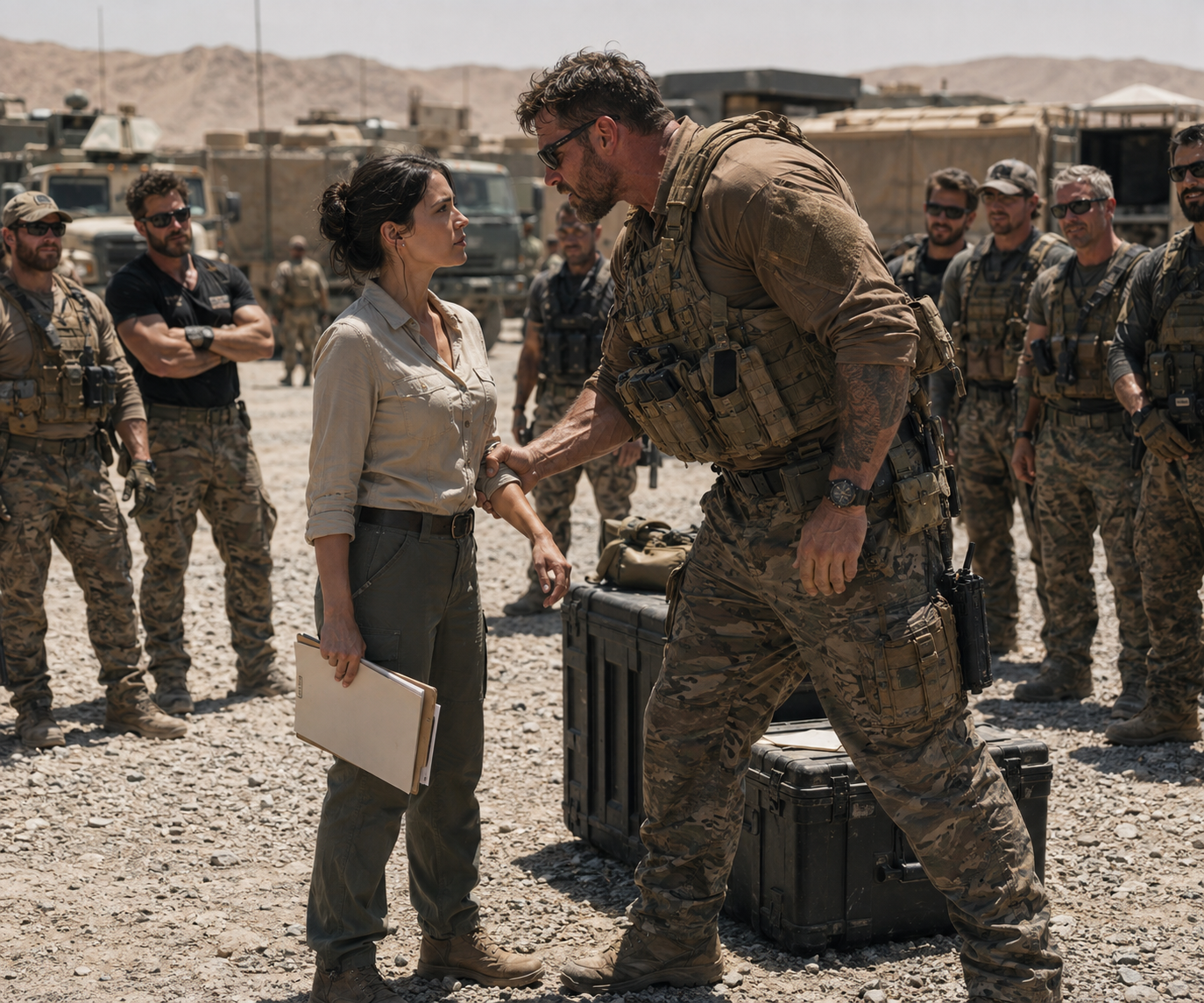
He stood in the middle of the parking lot at Forward Operating Base Viper, surrounded by supply trucks, ammunition crates, armored vehicles, and nearly two dozen operators who had suddenly found reasons to slow down. Dust drifted across the concrete in thin brown ribbons. The air smelled of fuel, hot metal, canvas, and the dry earth that seemed to cling to everything in Afghanistan.
Rourke was accustomed to being watched.
More importantly, he was accustomed to people changing their behavior when they realized he was watching them.
He was six feet four inches tall, broad through the shoulders, thick through the arms, and carried himself with the physical confidence of a man who had spent more than two decades learning how to survive environments designed to punish weakness. His uniform was immaculate despite the dust. His chest carried decorations that younger operators recognized immediately. His reputation had traveled through units before he ever arrived.
Master Chief Rourke Maddox was not merely experienced.
He was feared.
Not because he was cruel every minute of every day, but because he had developed the habit of treating disagreement as disrespect and respect as something owed to him automatically.
The woman standing in front of him was almost the exact opposite.
Dr. Mara Vale was small, quiet, plainly dressed, and apparently unarmed. She wore field khakis without combat patches, a faded tan shirt, practical boots, and no visible insignia that suggested she belonged anywhere near the operational hierarchy surrounding her.
She looked like someone who belonged in a laboratory.
Rourke had decided that within seconds.
He had been wrong.
He simply did not know it yet.
Mara stood beside three black transit cases, checking equipment serial numbers against a digital tablet. She had been working there for almost an hour. Operators had passed her without much interest. Some had glanced at the cases. A few had nodded politely.
Rourke had noticed her because one of the cases occupied a loading lane he considered his.
“Move your gear,” he said.
Mara did not look up.
“This lane was cleared through logistics command.”
Rourke stopped.
“I didn’t ask who cleared it.”
Mara checked another serial number.
“That is still the answer.”
A young operator near a supply truck coughed.
Another turned his face away.
Someone laughed quietly.
Rourke heard every sound.
His smile disappeared.
“Look at me when I’m talking to you.”
Mara lifted her eyes.
There was nothing aggressive in them.
That bothered him more than aggression would have.
“I am looking at you.”
For a moment, neither spoke.
Rourke glanced at the cases.
“What exactly are you supposed to be?”
“A civilian specialist.”
“That part was obvious.”
A few operators laughed.
Rourke enjoyed the reaction.
He had learned long ago that a crowd could be useful. When people laughed with him, they reinforced his authority. When they laughed at someone else, they reminded everyone who controlled the atmosphere.
“You people always show up with cases, clipboards, and expensive theories,” he said. “Then actual operators have to fix whatever you designed.”
Mara closed the tablet.
“The equipment inspection will be finished in twenty minutes.”
Rourke laughed.
“You still think this is about equipment?”
“No.”
Her answer came immediately.
The laughter faded.
Rourke took one step toward her.
“Then what is it about?”
“You being angry that someone is standing where you think you have the right to stand.”
Silence.
It was not a dramatic sentence.
She did not raise her voice.
She simply said it.
And somehow that made it worse.
Rourke looked around.
Several younger operators suddenly became very interested in their equipment.
He stepped closer.
“You scientists come into places like this and forget where you are.”
Mara’s eyes moved briefly toward his hands.
Then his shoulders.
Then the position of his feet.
Rourke did not notice.
“I know exactly where I am,” she said.
“Do you?”
“Yes.”
“Because from where I’m standing, you look like someone who has never been hit hard enough to understand the difference between theory and reality.”
The laughter returned, but weaker this time.
Mara waited.
Then she said quietly, “You should stop now.”
Rourke smiled.
“Was that a warning?”
“It was an opportunity.”
Something changed in the crowd.
Not much.
Just enough.
The experienced operators sensed it before the younger men did.
Rourke didn’t.
His pride had already committed him.
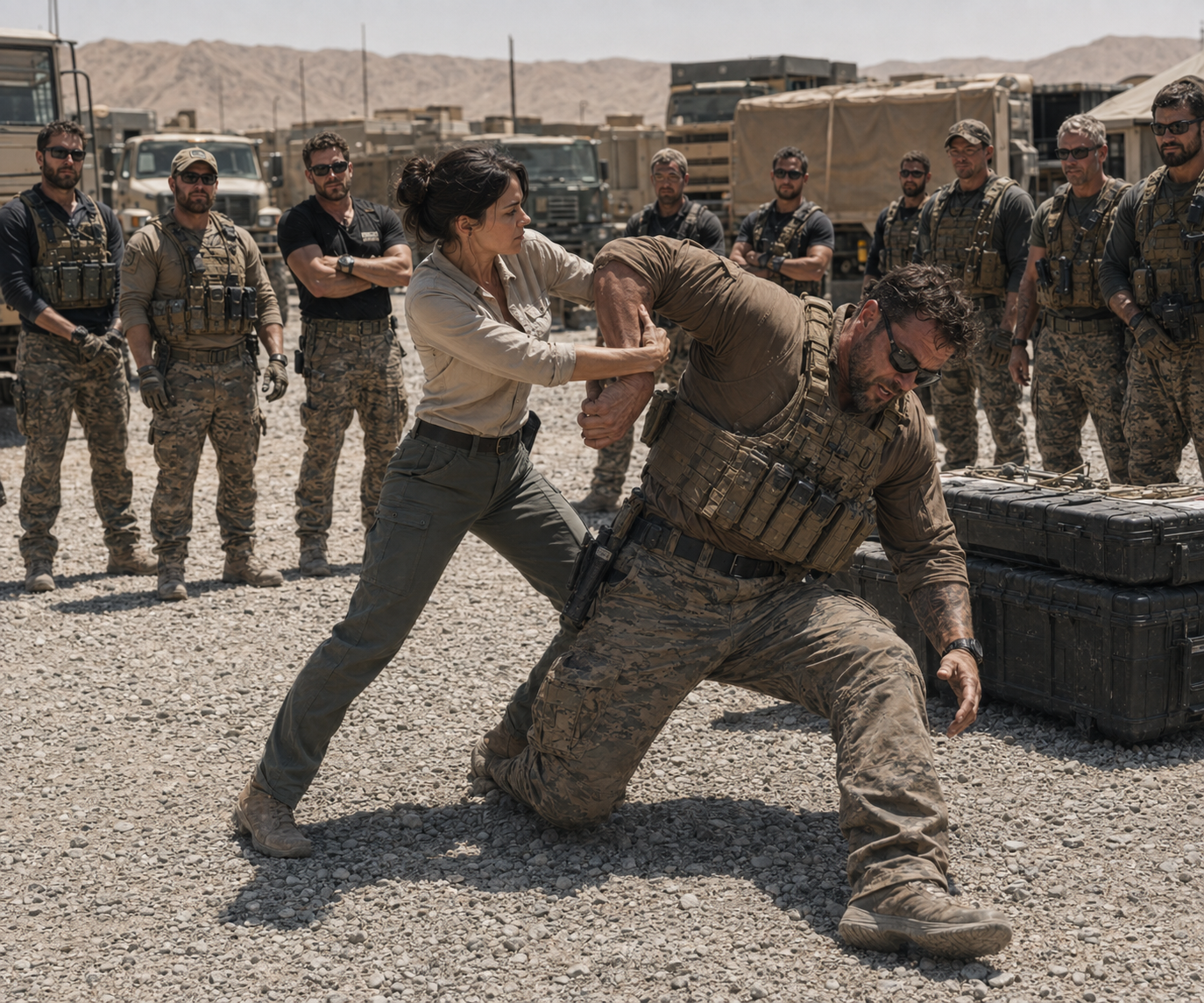
He reached out and grabbed Mara’s wrist.
The parking lot went silent.
“Take your hand off me,” Mara said.
Rourke tightened his grip.
“And if I don’t?”
Mara looked directly into his eyes.
“Then everyone here will learn something.”
Rourke smiled.
He never saw the movement that followed clearly enough to understand it.
Mara stepped forward instead of backward.
Her free hand guided his elbow.
Her shoulder shifted beneath his center of balance.
She rotated her hips a few degrees and redirected the force already contained inside his own body.
There was no wild swing.
No dramatic strike.
No display of superior strength.
She simply changed the direction in which his strength was allowed to travel.
Rourke’s expression changed.
For one impossible second, the largest man in the parking lot appeared to lose the relationship between his feet and the ground.
Mara stepped across his base.
His shoulder turned.
His balance disappeared.
And the asphalt rose toward him.
Rourke hit the ground.
Hard enough to make everyone understand.
Soft enough to leave him almost completely unharmed.
Mara had controlled the fall.
She released his wrist and stepped away.
Nobody laughed.
Nobody spoke.
Rourke remained on one knee.
His palms pressed against the hot pavement.
Dust clung to his uniform.
He looked up.
Mara was standing exactly where she had been before.
Calm.
Balanced.
Almost bored.
“You can get up,” she said.
Rourke’s face burned.
He slowly stood.
Before he could speak, another voice crossed the parking lot.
“Stand down.”
Colonel Adrian Cole approached from behind the operators.
The crowd separated immediately.
Cole was not a large man, but he possessed the kind of authority that required no volume. His gray hair was cut short, his uniform was worn without unnecessary decoration, and his expression suggested that he had already become tired of the situation before reaching it.
He stopped beside Rourke.
Then looked at Mara.
Then at the crowd.
“What exactly happened?”
Nobody answered.
Rourke opened his mouth.
Cole raised one hand.
“Don’t.”
Rourke closed it.
Cole looked at Mara.
“Doctor?”
“I redirected an unwanted grip.”
“That is one way to describe it.”
Mara sighed.
“Colonel.”
Cole turned toward the operators.
“You just watched Master Chief Maddox get taken to the ground by the woman who wrote the close-combat doctrine your teams have been training under for the last three years.”
Silence.
Rourke stared at him.
“What?”
Cole continued.
“Dr. Mara Vale is the principal architect of the Axiom close-quarters framework.”
The name moved through the crowd like electricity.
Axiom.
Every serious operator on the base knew it.
Axiom had become one of the most respected close-contact systems used by allied special operations units. It had replaced several older training concepts with a philosophy based on balance disruption, structural alignment, leverage, redirection, positional control, and the efficient use of an opponent’s own momentum.
It was taught in training facilities thousands of miles away.
It was referenced in manuals.
It was incorporated into simulations.
Operators had spent months learning its principles.
Rourke had spent years claiming he had mastered them.
He looked at Mara.
She did not look proud.
She did not look pleased.
She looked irritated that Colonel Cole had revealed her identity.
Rourke swallowed.
“You wrote Axiom?”
“Yes.”
He stared at her.
“You?”
Mara raised an eyebrow.
“Yes.”
The parking lot seemed suddenly much larger.
Rourke looked down at his hands.
Then at the place where he had fallen.
Then back at her.
Cole continued.
“And apparently Master Chief Maddox needed a practical refresher.”
One of the younger operators almost smiled.
Cole’s eyes moved toward him.
The smile disappeared.
“Five years ago,” Cole said, “an allied diplomatic delegation in Ankara was targeted by an eight-man contract team. Their security detail was overwhelmed within thirty seconds.”
Rourke listened.
He knew the incident.
Everyone in certain circles knew it.
What he did not know was what came next.
“The attackers expected armed security,” Cole said.
He looked at Mara.
“They did not expect her.”
Mara’s expression hardened.
“Colonel.”
“You saved twelve people.”
“That incident is irrelevant.”
“It is relevant to the lesson.”
“It was five years ago.”
“And the lesson is still current.”
Mara shook her head.
Cole continued anyway.
“Dr. Vale was not carrying a rifle. She did not have a tactical team behind her. She did not overpower eight men.”
He paused.
“She survived because she understood the environment better than the people trying to control it.”
Rourke looked at Mara differently.
For the first time, he noticed details he had ignored.
She never stood with both feet pointed directly at another person.
She kept one shoulder slightly angled.
She never allowed herself to become trapped between vehicles.
She noticed every hand.
Every doorway.
Every movement.
She had been reading the parking lot since she arrived.
Not because she was nervous.
Because that was how she existed.
Cole folded his arms.
“Master Chief Maddox.”
Rourke straightened.
“Sir.”
“Effective immediately, you are suspended from field team leadership pending formal review.”
The words landed heavily.
Rourke’s jaw tightened.
“Sir?”
“You heard me.”
“On what grounds?”
“Conduct unbecoming of a senior operator. Unnecessary physical contact with a civilian specialist. Abuse of authority. And a demonstrated failure of judgment.”
Rourke looked around.
The younger operators were no longer laughing.
They were watching him carefully.
He hated that more than the order.
“Where am I being reassigned?”
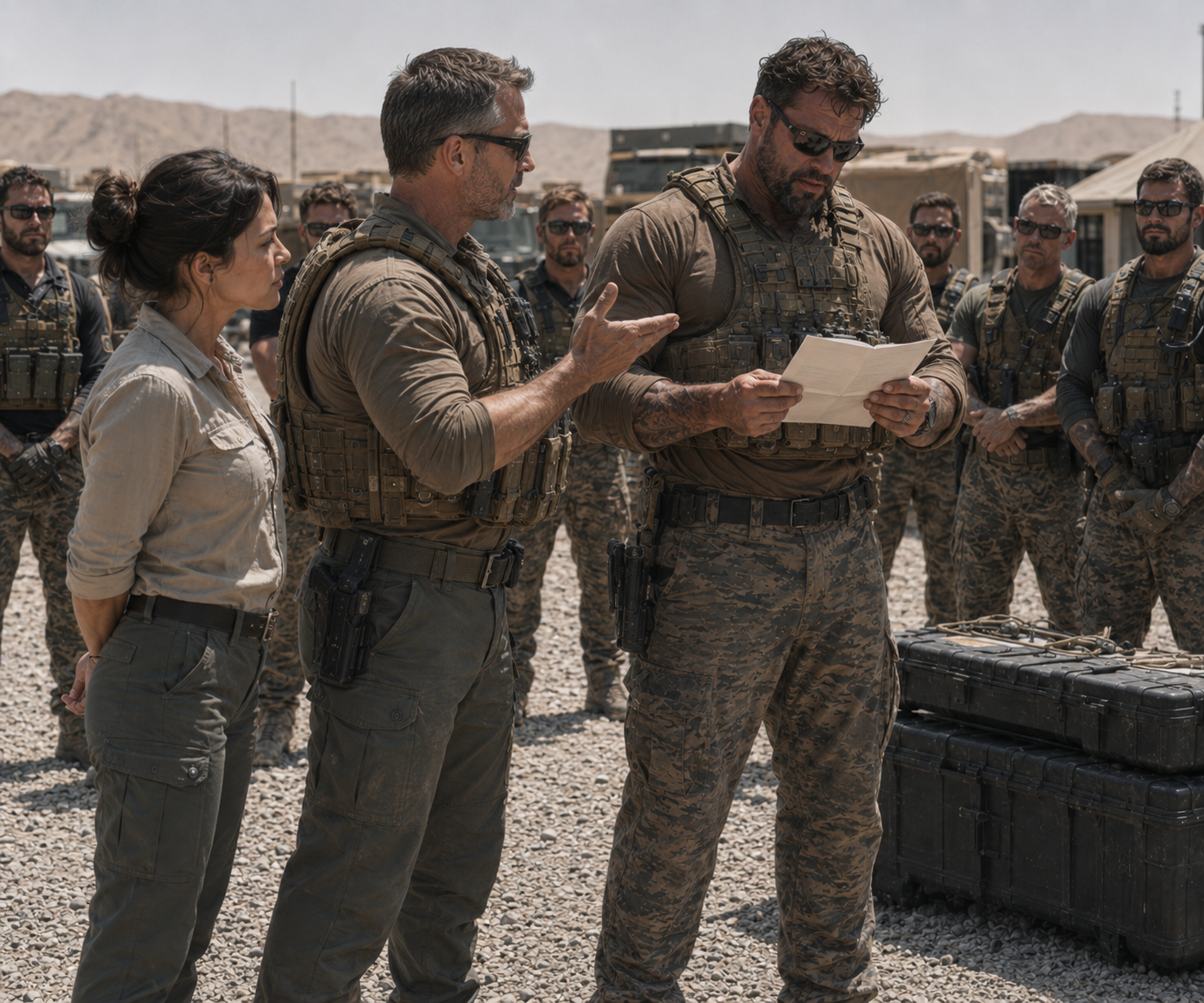
Cole handed him a folded document.
“Training Bay Three.”
Rourke unfolded it.
He read the first page.
Then the second.
His eyes stopped.
“Tomorrow?”
“0600.”
He looked up.
“Training?”
“Yes.”
“With whom?”
Cole looked at Mara.
Then back at him.
“Dr. Vale.”
Rourke stared.
“You’re making me her student?”
Cole’s expression did not change.
“No.”
He paused.
“Your behavior made you her student. I’m only formalizing it.”
A silence followed.
Rourke folded the paper.
His hands were rigid.
“Sir, with respect, I have twenty-three years in special operations.”
Mara finally spoke.
“That should make learning easier.”
Rourke turned toward her.
There was no sarcasm in her voice.
That made the sentence harder to dismiss.
“And if I don’t?”
Mara looked toward Training Bay Three.
“Then nothing I teach you will matter.”
She picked up one of the black cases.
“Your choice.”
Then she walked away.
The crowd slowly dispersed.
Rourke remained standing in the center of the parking lot.
For the first time in twenty-three years, he had no idea what to say.
He had spent his career believing that strength was the ability to impose his will on a situation.
That morning, a woman half his size had shown him something more uncomfortable.
Strength could also mean refusing to impose anything at all.
It could mean understanding exactly how much force was necessary.
And, more importantly, how much was not.
That night, Rourke did not sleep well.
He replayed the fall.
Again.
And again.
He tried to reconstruct the movement.
The angle of her shoulder.
The position of his feet.
The pressure of her hand.
The shift in his center of gravity.
He had trained Axiom.
He knew the terminology.
He knew the sequences.
He knew the names of the principles.
But he had never experienced them from the wrong side.
Now he understood why that mattered.
He had always practiced the system as an operator.
Mara had designed it as a problem.
There was a difference.
At 0554 the next morning, Rourke entered Training Bay Three.
Mara was already there.
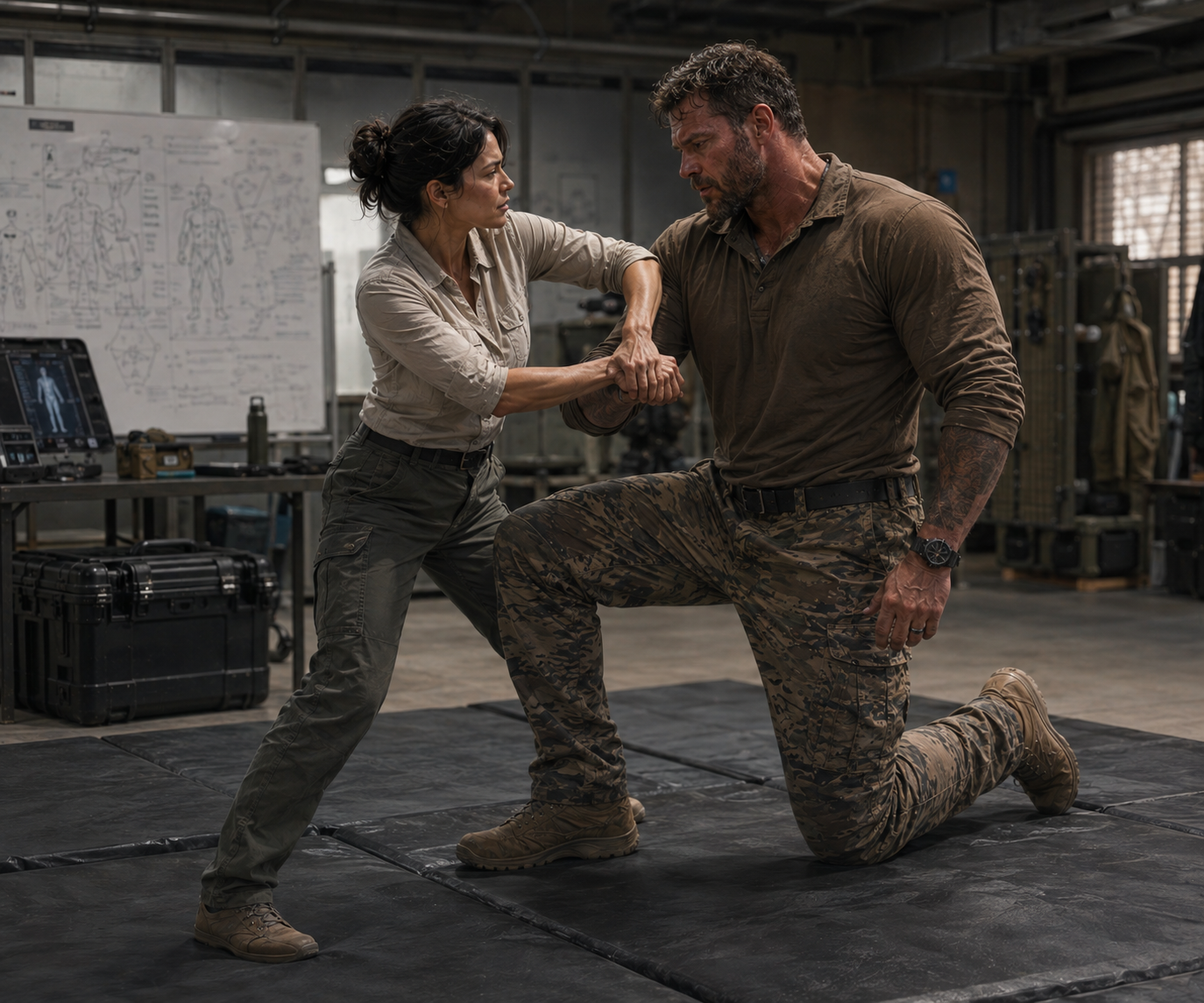
The room was large and quiet.
Rubber mats covered the floor.
A whiteboard stood against one wall.
Several training mannequins rested in the corner.
A black equipment case sat near the entrance.
Rourke recognized it immediately.
Mara glanced at the clock.
“You’re early.”
“Six minutes.”
“That still counts.”
Rourke stepped onto the mat.
Mara pointed toward the center.
“Stand there.”
He obeyed.
She approached.
For several seconds, neither spoke.
Then Mara asked, “Why did you fall yesterday?”
Rourke almost answered immediately.
Because you were faster.
Because I underestimated you.
Because you surprised me.
Because you used leverage.
Because you are trained.
He knew all of those answers would be incomplete.
He looked at the mat.
“Because I underestimated you.”
Mara shook her head.
“That is why you grabbed me.”
Rourke looked up.
“You fell because you committed your weight before you understood what I could do with it.”
He said nothing.
“Your strength wasn’t the problem.”
She walked around him.
“Your strength was predictable.”
Rourke watched her.
“You built your entire movement around the assumption that the person in front of you would respond the way you expected.”
She stopped in front of him.
“That assumption is dangerous.”
Rourke exhaled.
“So arrogance created the mistake.”
“Arrogance created the opportunity.”
She tapped the mat with her boot.
“Physics punished it.”
For the first time, Rourke almost smiled.
“That’s a very scientific way to insult someone.”
“I wasn’t insulting you.”
“That might be worse.”
Mara gave the smallest hint of a smile.
Then she extended her wrist.
“Grab it.”
Rourke hesitated.
She noticed.
“That hesitation is already more useful than yesterday.”
He carefully took her wrist.
Mara adjusted his fingers.
“Less tension.”
He loosened his grip.
“Again.”
He repeated the movement.
Mara moved slowly.
She showed him how his elbow shifted.
How his shoulder tightened.
How his weight traveled through his hips.
How a stronger grip could actually become a liability.
Rourke listened.
For twenty minutes, he did not interrupt.
Then Mara stepped away.
“You know most of these movements.”
“I trained Axiom for three years.”
“No.”
Rourke frowned.
“You memorized Axiom.”
She pointed toward his head.
“You know the answers.”
Then she touched his chest.
“You never learned the question.”
Rourke stood still.
That sentence stayed with him.
Mara walked toward the black case.
“Axiom was never designed to make people dangerous.”
Rourke followed her with his eyes.
“It was designed to make them difficult to control.”
She opened the case.
Inside were compact sensors, motion trackers, pressure monitors, training devices, and several pieces of equipment Rourke had never seen.
“A combat system becomes dangerous when people confuse efficiency with superiority,” Mara said.
She lifted one sensor.
“That’s why I came here.”
“To test Axiom?”
“To observe it.”
She placed the sensor on the table.
“Without telling anyone who I was.”
Rourke understood.
“You didn’t want people changing their behavior because they knew the architect was watching.”
“Exactly.”
“And I ruined your evaluation.”
Mara considered that.
“No.”
She closed the case.
“You improved it.”
Rourke frowned.
“How?”
“You revealed something I couldn’t measure with equipment.”
“What?”
“The system has evolved faster than the culture using it.”
Rourke stared at her.
Mara continued.
“Axiom teaches people to control position before controlling force. But some operators still believe being stronger gives them authority.”
She looked at him.
“That is not a technical failure.”
“It is a human one.”
Rourke lowered his eyes.
He had spent years teaching younger operators that hesitation could kill them.
Now he was beginning to understand that certainty could kill them too.
The lesson continued.
For the next several weeks, Rourke reported to Training Bay Three every morning.
At first, he hated it.
He hated the room.
He hated the silence.
He hated being corrected.
Most of all, he hated how often Mara was right.
She never shouted.
She never humiliated him.
She never reminded him that she had put him on the ground.
That made the training harder.
Rourke discovered that he could handle pain more easily than correction.
Pain was simple.
Correction forced him to admit that something he believed about himself was wrong.
On the fourth day, Mara told him he was using too much strength.
On the sixth day, she told him he was moving too quickly.
On the ninth day, she told him he was thinking too much.
On the twelfth day, she told him he was finally beginning to understand.
That sentence meant more to him than any medal he had ever received.
Their relationship changed slowly.
Rourke stopped calling the training punishment.
Mara stopped treating him like a problem.
They began discussing doctrine.
Then leadership.
Then decision-making.
Then fear.
One morning, after a difficult session, Rourke sat against the wall drinking water.
“I have a question.”
Mara was collecting the sensors.
“Ask.”
“Why did you create Axiom?”
She paused.
For the first time, she did not answer immediately.
“Because someone stronger than me once decided strength meant they were entitled to control me.”
Rourke looked at her.
Mara continued.
“I was nineteen.”
She sat across from him.
“It was not a military situation. It wasn’t even particularly dramatic. But I remember what it felt like.”
“What happened?”
“I realized something.”
“What?”
“That I had spent my entire childhood being told that strength belonged to people who could take it.”
She looked down at her hands.
“So I became interested in the opposite.”
“Control without domination.”
“Yes.”
Rourke nodded slowly.
“How did you go from that to military doctrine?”
“Years of study.”
“Martial arts?”
“Among other things.”
“Physics?”
“Obviously.”
“Psychology?”
“Especially psychology.”
She smiled faintly.
“Most confrontations are decided before physical contact.”
Rourke thought about the parking lot.
“You mean by perception.”
“By expectation.”
She looked at him.
“People behave according to the story they have already written about the person in front of them.”
Rourke understood.
He had written Mara’s story in seconds.
Civilian.
Small.
Unarmed.
Scientist.
Irrelevant.
He had never questioned it.
That story had blinded him.
Mara stood.
“That is why I don’t care whether someone is physically stronger than me.”
“Why?”
“Because I care whether they believe they already understand me.”
Rourke smiled.
“That sounds dangerous.”
“It is.”
Another week passed.
Then another.
The story of the parking lot eventually became part of the unofficial mythology of the base.
Some versions claimed Mara had thrown Rourke across the entire parking lot.
Others claimed she had beaten three operators simultaneously.
One particularly imaginative version claimed she had disarmed him using a clipboard.
Mara found the stories amusing.
Rourke pretended not to care.
But something else had changed.
The younger operators had started watching him differently.
Not because he had become weaker.
Because he had become quieter.
He corrected mistakes without shouting.
He began asking questions.
He stopped interrupting junior operators.
When a new specialist entered a planning meeting, Rourke no longer assumed the specialist knew less simply because they wore fewer insignia.
He began saying something that surprised everyone.
“Let’s hear the person who built the system.”
It became a habit.
Then one morning, the base received a serious alert.
A convoy scheduled to move through a narrow mountain route had been compromised.
Intelligence indicated that an armed group had studied the convoy’s normal security patterns.
The mission commander assembled the senior team.
Rourke was still suspended from field leadership, but Cole asked him to attend.
Mara was there as well.
The briefing room was crowded.
A satellite image covered the main screen.
The convoy route passed between steep rock formations where visibility was limited.
One officer pointed to the map.
“We expect contact here.”
Another said, “We can increase the forward security element.”
Rourke listened.
Then Mara spoke.
“They know you’re going to do that.”
Everyone looked at her.
She pointed to the route.
“They’ve studied your response patterns.”
The room became quiet.
“They expect you to reinforce the obvious vulnerability.”
An officer frowned.
“Then what do you suggest?”
Mara looked at Rourke.
He understood before she spoke.
“Change the pattern.”
He stepped toward the screen.
“The threat isn’t the route.”
He pointed to the surrounding terrain.
“The threat is that they know how we’ll behave when we reach it.”
Mara nodded.
Rourke continued.
“We’re thinking about where they will attack.”
He looked at the team.
“We should be thinking about what they believe we’ll protect.”
The room shifted.
The mission plan changed.
Not dramatically.
Just enough.
The convoy moved at a different time.
The security formation changed.
A decoy vehicle created the expectation of a predictable response.
The ambush never came.
Later, intelligence confirmed that the attackers had been positioned exactly where the original convoy would have been most vulnerable.
The team had not defeated the enemy through superior firepower.
They had defeated the enemy’s expectation.
That evening, Rourke found Mara outside the training building.
“You knew.”
“I suspected.”
“You changed the plan.”
“We changed it together.”
Rourke looked at the desert horizon.
“Six weeks ago, I would have called that overthinking.”
Mara smiled.
“Six weeks ago, you would have called it weakness.”
Rourke nodded.
“That too.”
They stood in silence.
Then he said, “You know what bothers me?”
“What?”
“I thought being strong meant never allowing anyone to move me.”
Mara looked at him.
“And now?”
Rourke smiled.
“Now I think strength might mean knowing when to move.”
Mara nodded.
“That is closer.”
“Closer?”
“You still think strength is about you.”
Rourke laughed.
“Fair.”
She looked toward the horizon.
“Real strength is what happens to the people around you because you have it.”
Rourke considered that for a long time.
“What do you mean?”
“If your strength makes everyone afraid to speak, you’ve created silence.”
She looked at him.
“If your strength makes people more capable, you’ve created leadership.”
The words followed him for years.
Months later, Rourke returned to field command.
His formal review concluded without ending his career.
In fact, Colonel Cole gave him something more difficult than punishment.
Responsibility.
Rourke was assigned to help integrate Axiom into advanced leadership training.
At first, he resisted.
“I am not a doctrine instructor.”
Cole looked at him.
“Neither was she when she started.”
Rourke sighed.
“That’s different.”
“How?”
“She actually understands it.”
Cole smiled.
“You’re beginning to.”
Rourke accepted the assignment.
His first class was a room full of experienced operators.
Men and women who had survived firefights, hostage rescues, aircraft crashes, failed missions, and the kind of nights that left memories no one discussed.
Rourke stood at the front.
He looked at them.
Then he put the prepared lesson aside.
“Before we start,” he said, “I want you to understand something.”
Everyone watched him.
“I spent years believing that strength gave me authority.”
He paused.
“It doesn’t.”
The room remained silent.
“Strength gives you responsibility.”
He looked toward the back wall.
“And responsibility means understanding what your strength does to everyone around you.”
He began teaching.
Not from memorized sequences.
From experience.
He taught them how to recognize balance.
How to recognize fear.
How to recognize the moment when confidence becomes arrogance.
How to distinguish decisiveness from impulsiveness.
How to listen to someone whose uniform carried fewer decorations.
How to understand that the most dangerous person in a room was not always the person who could hit the hardest.
Sometimes it was the person who believed they had nothing left to learn.
Mara watched from the observation room.
Colonel Cole stood beside her.
“He’s changed.”
“Yes.”
“Did you expect that?”
“No.”
Cole looked at her.
“You were hard on him.”
“I was honest with him.”
“Same thing, sometimes.”
Mara smiled.
“He did the difficult part.”
“What was that?”
“He stopped defending the person he thought he had to be.”
Inside the classroom, Rourke continued.
“Axiom isn’t a collection of techniques,” he said.
A student raised a hand.
“Then what is it?”
Rourke looked at the person.
“An argument.”
“Against what?”
“Against the belief that force is the only form of control.”
He paused.
“Sometimes the strongest thing you can do is refuse to become the person your opponent expects.”
The students listened.
Rourke looked toward the observation window.
For a moment, he saw Mara standing there.
The same woman who had once appeared to him insignificant.
The same woman he had tried to intimidate.
The same woman who had put him on the ground without anger.
He finally understood why she had not mocked him after the fall.
She did not need to.
The lesson had already begun.
Years later, when younger instructors told the story of Master Chief Rourke Maddox being dropped in a parking lot by a civilian woman, Rourke never corrected them.
He only corrected one part.
“She wasn’t just some civilian.”
The younger operators would laugh.
“Sir, we know.”
“No,” Rourke would say.
“You don’t.”
Then he would tell them the story.
Not the exaggerated version.
Not the funny version.
The real one.
He would tell them about the black cases in the parking lot.
The dust.
The crowd.
The grip on Mara’s wrist.
The moment his feet stopped belonging to him.
He would tell them how humiliation had felt like heat beneath his skin.
He would tell them about Training Bay Three.
And then he would tell them the lesson Mara had taught him.
“Strength is not proven by how easily you can put someone on the ground.”
He would pause.
“Strength is proven by how carefully you decide whether they need to go there.”
The younger operators usually became quiet.
Then someone would ask the inevitable question.
“Did she really create Axiom?”
Rourke would smile.
“Yes.”
“Did she really take you down that easily?”
“Yes.”
“Could you beat her now?”
That question always made him laugh.
“No.”
Sometimes the younger operators would be surprised.
“You’ve trained with her for years.”
“I know.”
“So you still can’t beat her?”
Rourke would shake his head.
“You’re asking the wrong question.”
“What is the right one?”
Rourke would look toward the training floor.
“The right question is whether I need to.”
That answer usually ended the conversation.
Because by then, the lesson had become clear.
Mara Vale had never wanted to prove she was stronger than Rourke Maddox.
She had wanted him to understand that strength was never the point.
The doctrine she built was not really about fighting.
It was about control.
Not controlling other people.
Controlling yourself.
Your fear.
Your ego.
Your assumptions.
Your need to dominate a room simply because you can.
The greatest danger in any confrontation was not always the person standing across from you.
Sometimes it was the story you had already decided was true.
Rourke learned that in a parking lot beneath the Afghan sun.
Mara had learned it years before.
That was why she had built Axiom.
That was why she could stand calmly in front of someone twice her size.
That was why she had not been afraid when his hand closed around her wrist.
She understood something he had spent twenty-three years forgetting.
The person who needs to prove they are powerful has already surrendered part of their power.
The person who understands their strength does not need to announce it.
And the person who truly deserves strength uses it to make others stronger.
One morning, long after the incident had become history, Rourke entered Training Bay Three before sunrise.
The room was empty.
He walked to the center of the mat.
For a moment, he remembered the first morning he had stood there.
Angry.
Embarrassed.
Defensive.
Certain that he had been humiliated.
Now he understood differently.
He had not been humiliated.
He had been introduced to himself.
Mara entered carrying two cups of coffee.
She handed one to him.
“You’re early.”
Rourke smiled.
“Six minutes.”
“That still counts.”
They stood together in the quiet training room.
Outside, the sun began to rise.
Mara looked at him.
“Ready?”
Rourke nodded.
“Always.”
She raised an eyebrow.
He laughed.
“Sorry.”
“What?”
“Old habits.”
Mara smiled.
“Good.”
She stepped onto the mat.
Rourke followed.
Neither needed to say anything else.
The lesson continued.
Not because Rourke was weak.
Not because Mara was stronger.
But because both of them understood something that had taken years to become obvious.
A doctrine is only as powerful as the people willing to live by it.
A leader is only as strong as the people who become stronger because of them.
And sometimes, the person who changes an entire generation of warriors does not arrive carrying a weapon.
Sometimes she arrives carrying a black case, a clipboard, and an idea nobody understands.
Sometimes she stands quietly while the strongest man in the room mistakes silence for weakness.
And sometimes, the most important lesson a warrior will ever learn begins with four simple words.
“Take your hand off me.”
Because the moment Rourke Maddox reached for Mara Vale, he thought he was demonstrating power.
Instead, he discovered the woman who had spent her life teaching the world what power actually meant.
She did not defeat him with strength.
She defeated his assumption.
And that was the beginning of everything.
Years afterward, Axiom would continue evolving.
New instructors would modify its training.
New operators would test its principles.
New generations would learn its methods.
Some would remember the technical terminology.
Some would remember the diagrams.
Some would remember the training sequences.
But those who had learned directly from Mara remembered something simpler.
Position before force.
Awareness before action.
Control before dominance.
And humility before strength.
That was the doctrine.
That was the lesson.
And that was the legacy of the quiet woman who walked into a military parking lot carrying three black cases and walked out having changed the strongest man in the room.