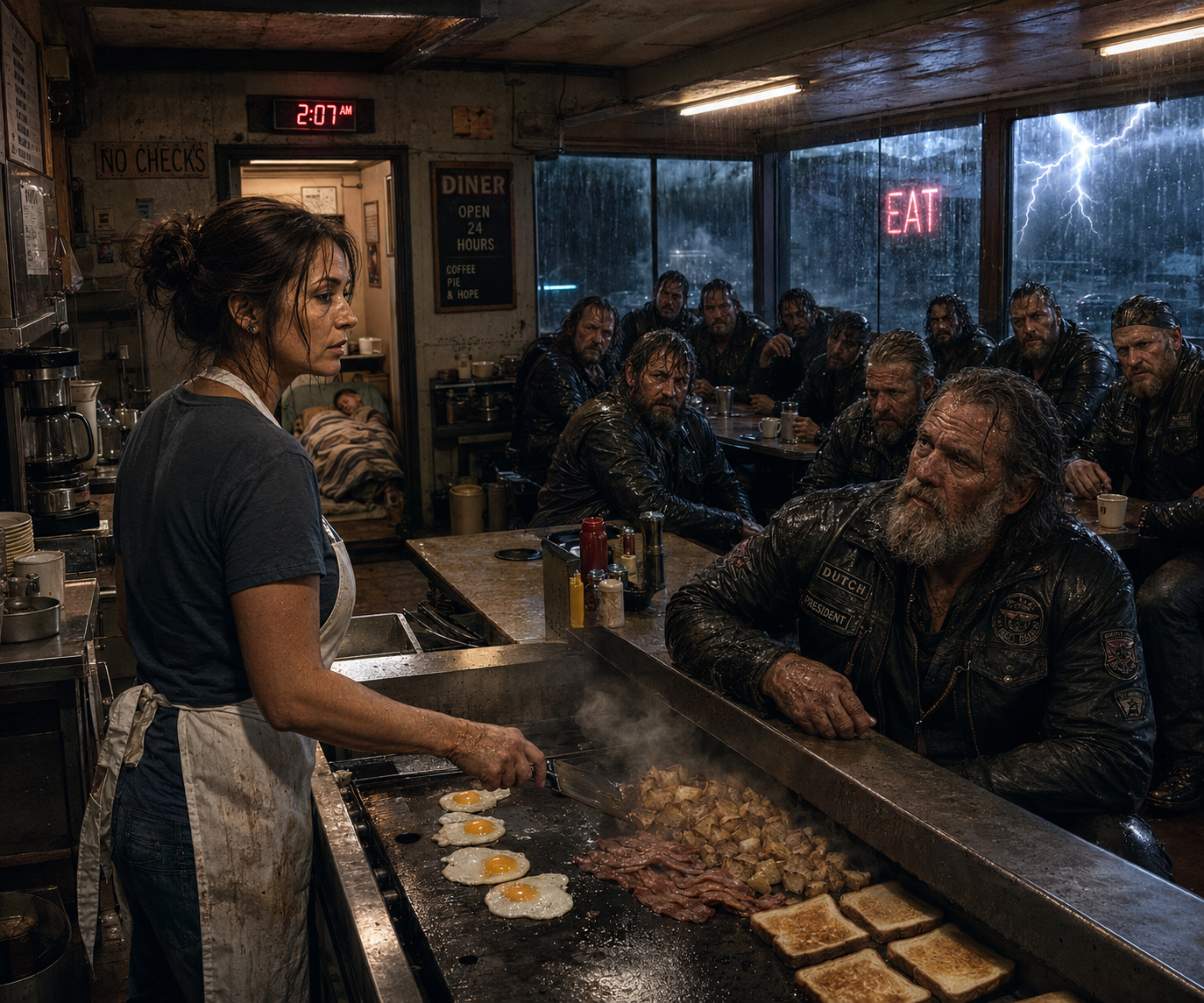
Sarah had learned a long time ago that an empty diner could be louder than a crowded one.
When there were customers, there were forks scraping plates, coffee cups clinking against saucers, truckers laughing at the counter, and the old jukebox in the corner fighting to be heard over the kitchen fan.
But lately, there was mostly silence.
At 2:07 in the morning, the only sounds inside Sarah’s roadside diner were the rain striking the windows and the occasional groan of the building as another powerful gust of wind swept across the highway.
The storm had been getting worse for hours.
Part of the highway had washed out several miles south.
Traffic had stopped.
The local news station had warned everyone to stay off the roads.
Sarah had no customers.
No business.
And almost no food.
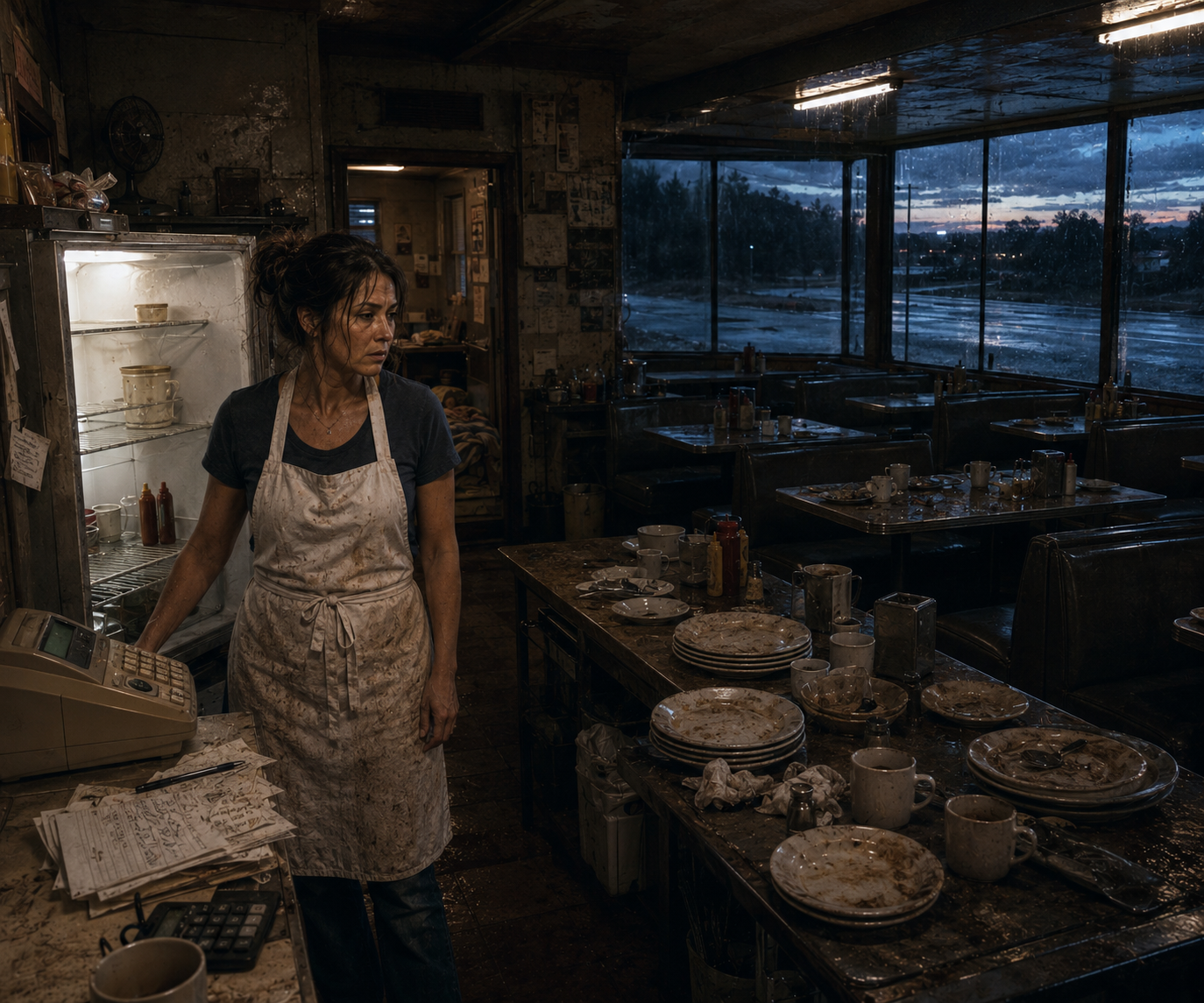
She stood behind the counter, staring at the register.
The numbers were terrible.
The bank had called twice that week.
The electric company had already sent a final notice.
The refrigerator was dying.
The roof leaked above the kitchen.
And the diner itself had been losing money for months.
Sarah had spent most of her adult life keeping the place alive.
Her father had opened it thirty-two years earlier.
After he died, she took over.
For years, the diner had been the kind of place where people knew your name.
Then the new interstate bypass opened.
Cars stopped coming.
Truckers found faster routes.
Restaurants with brighter signs and cheaper menus appeared along the highway.
Sarah refused to close.
Not because she was stubborn.
Because there was nowhere else to go.
Her six-year-old son, Ben, slept in the little office behind the kitchen.
He was curled beneath a faded blue blanket on an old couch.
Sarah checked on him every night.
She knew he was asleep when the storm suddenly seemed less frightening.
She turned toward the kitchen.
There was enough food for perhaps one more busy morning.
Eggs.
Bacon.
Potatoes.
Bread.
A few cans of soup.
That was almost everything.
She had planned to stretch it until Sunday.
Then the front door opened.
The bell above it rang once.
Sarah froze.
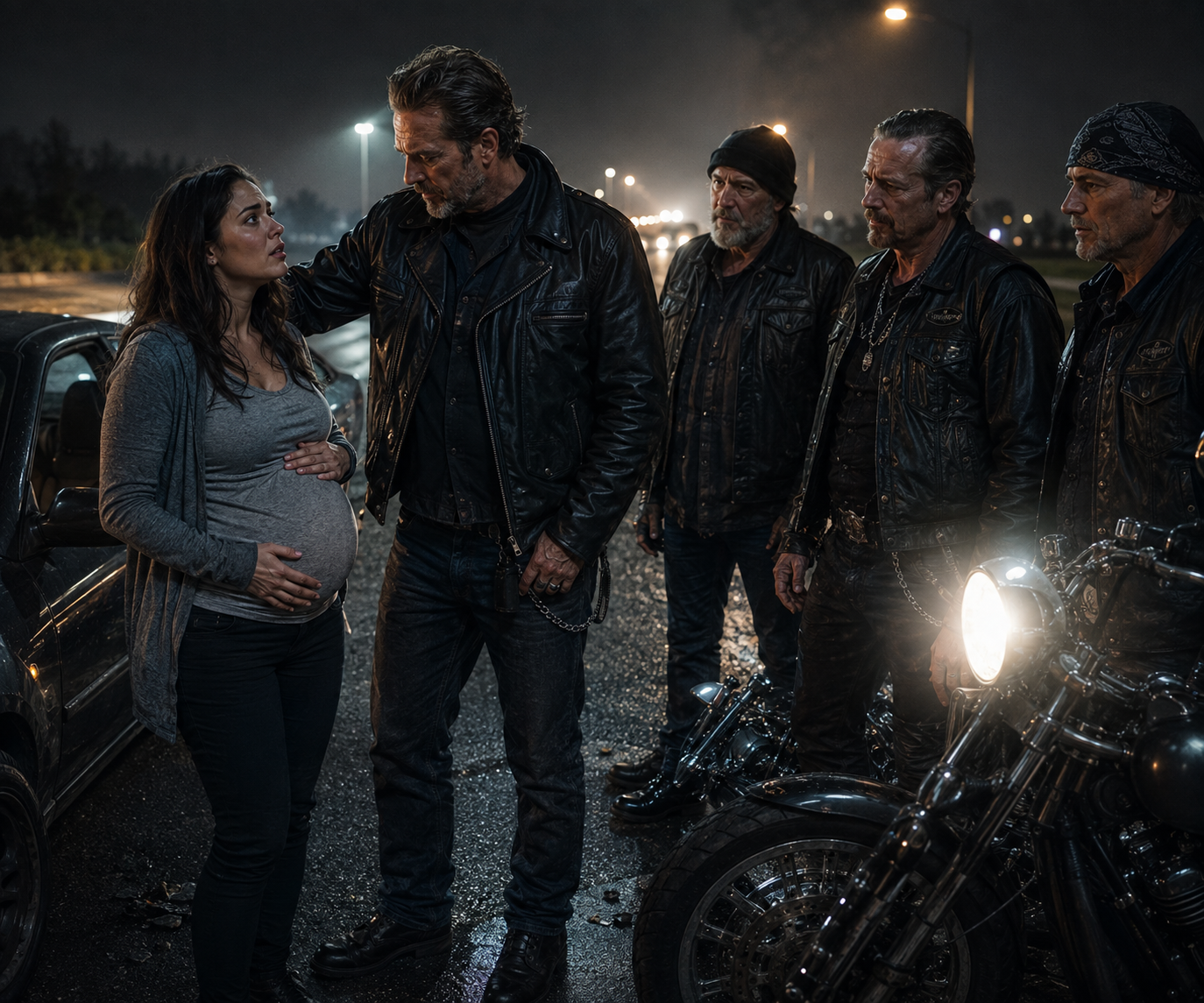
Twelve men walked inside.
They were soaked.
Their boots left puddles on the worn wooden floor.
Leather vests clung to their shoulders.
Water streamed from their jackets.
Several had gray beards.
One man was visibly shaking.
Another rubbed his hands together.
Sarah’s first thought was that they looked dangerous.
Her second thought was that they looked exhausted.
Their leader stepped forward.
He was a large man with a white beard and a scar running from his left eyebrow to his cheek.
His vest carried a patch Sarah recognized.
She had seen it on motorcycles passing the diner for years.
He removed his gloves.
“Sorry to bother you.”
Sarah looked at the clock.
“It’s two in the morning.”
The man glanced at the rain outside.
“We noticed.”
Despite herself, Sarah almost smiled.
“Highway?”
“Washed out.”
“How far?”
“About three miles south.”
Sarah sighed.
“You guys need somewhere to wait?”
The man nodded.
“If that’s okay.”
Sarah looked at the twelve men.
Then toward the kitchen.
Then toward the office.
Her son was asleep.
She had twelve strangers standing inside her dying diner.
And almost no food.
She could have told them the kitchen was closed.
She could have locked the door.
She could have told them to wait in their motorcycles.
Instead, she said the words that would change her life.
“Sit down.”
The leader hesitated.
“We can pay.”
Sarah looked at him.
“You can barely stand.”
One of the bikers laughed weakly.
“She’s got us there.”
They slowly took seats.
Sarah walked into the kitchen.
She opened the refrigerator.
Six eggs.
A package of bacon.
Half a bag of potatoes.
She looked at the bread.
Then at the men.
She closed the refrigerator.
“All right.”
She turned on the grill.
The first egg hit the hot surface.
Then another.
Bacon began to sizzle.
She sliced potatoes.
She added toast.
The smell spread through the diner.
The men watched.
Nobody spoke.
Sarah cooked faster than she thought she could.
One plate became three.
Three became six.
Six became twelve.
Then she realized twelve men were not going to be enough.
They were still hungry.
So she made more.
She used almost everything.
Every egg.
Every strip of bacon.
Every potato.
Most of the bread.
When she finished, the kitchen looked empty.
But the twelve men were eating.
And Sarah watched them.
The leader took one bite and closed his eyes.
“Ma’am…”
Sarah wiped her hands on a towel.
“What?”
“This is the best meal I’ve had in years.”
She snorted.
“You’ve been eating terrible food.”
The man smiled.
“Probably.”
“What do I call you?”
“Dutch.”
“Dutch?”
“Nickname.”
“Real name?”
He smiled.
“You don’t want to remember that.”
Sarah laughed.
“Fair enough.”
The bikers ate quietly.
One of them kept staring at his plate.
Sarah noticed.
“You okay?”
He nodded.
“Just haven’t eaten since yesterday.”
Sarah didn’t say anything.
She simply put another piece of toast on his plate.
The man looked up.
“Thank you.”
She nodded.
“Eat.”
After the last plate was empty, Dutch stood.
He pulled out his wallet.
Sarah immediately shook her head.
“No.”
He stopped.
“How much?”
“Nothing.”
“We can’t do that.”
Sarah folded her arms.
“Did I ask you for a wallet?”
Dutch looked at her.
Then he smiled.
“No.”
“Then put it away.”
He slowly returned the wallet to his pocket.
“You sure?”
Sarah sighed.
“No.”
Dutch laughed.
“That might be the most honest answer I’ve heard all year.”
Sarah smiled.
“Get some sleep.”
The men rested for another hour.
Then, just before sunrise, the storm weakened.
Dutch stood by the door.
“Thank you.”
Sarah waved him off.
“Drive carefully.”
Dutch looked back at her.
“We will.”
The twelve men stepped outside.
Their engines roared to life.
One by one, the motorcycles disappeared into the storm.
Sarah locked the door.
Then she turned around.
The diner was silent.
Twelve empty plates.
Dirty dishes.
An empty refrigerator.
She opened the freezer.
Nothing useful.
She looked at the bread shelf.
Empty.
She stared at the kitchen.
Then at the bills beside the register.
Her shoulders dropped.
“What have I done?”
She had just fed twelve strangers with the food she needed to survive the weekend.
Kindness suddenly felt expensive.
Sarah sat down.
She rubbed her eyes.
Then she remembered Ben.
She walked into the office.
Her son was still asleep.
She pulled the blanket higher around him.
“You better appreciate those bikers someday,” she whispered.
Ben opened one eye.
“Who?”
“Nobody.”
He smiled sleepily.
“Mom?”
“Yes?”
“Did you feed people again?”
Sarah smiled.
“Go back to sleep.”
He did.
Sarah returned to the dining room.
She turned off the lights.
Then she heard something.
A low vibration.
At first, she thought it was thunder.
Then the windows rattled.
Sarah froze.
The vibration became louder.
She walked toward the front door.
Another sound joined it.
Then another.
Then dozens.
She opened the door.
One motorcycle appeared over the hill.
Then another.
Then another.
Sarah stared.
The road was filling with headlights.
Ten.
Twenty.
Fifty.
The line continued.
She stepped onto the porch.
Her mouth fell open.
The motorcycles stretched as far as she could see.
Her heart began pounding.
“What is happening?”
She counted until she lost track.
The road was full.
Both sides.
The parking lot.
The shoulder.
The surrounding field.
Motorcycles everywhere.
Then Ben appeared behind her.
“Mom?”
Sarah turned.
“Go back inside.”
“Why?”
“Just go.”
“Are they the people you fed?”
Sarah didn’t answer.
The motorcycles stopped.
Engines shut off.
Silence fell over the highway.
Hundreds of bikers climbed off their motorcycles.
Eight hundred.
Maybe more.
All wearing leather.
All carrying the same patch.
Sarah recognized it.
The Black Ridge Riders.
She had seen the patch for years.
People talked about them.
Some called them dangerous.
Others called them criminals.
But nobody ever talked about what happened when someone helped one of them.
At the front of the crowd stood Dutch.
He removed his helmet.
Walked toward the diner.
And smiled.
Sarah stared at him.
“How many people are there?”
Dutch looked over his shoulder.
“About eight hundred.”
Sarah almost laughed.
“Why?”
“You fed twelve hungry bikers last night.”
“Yes.”
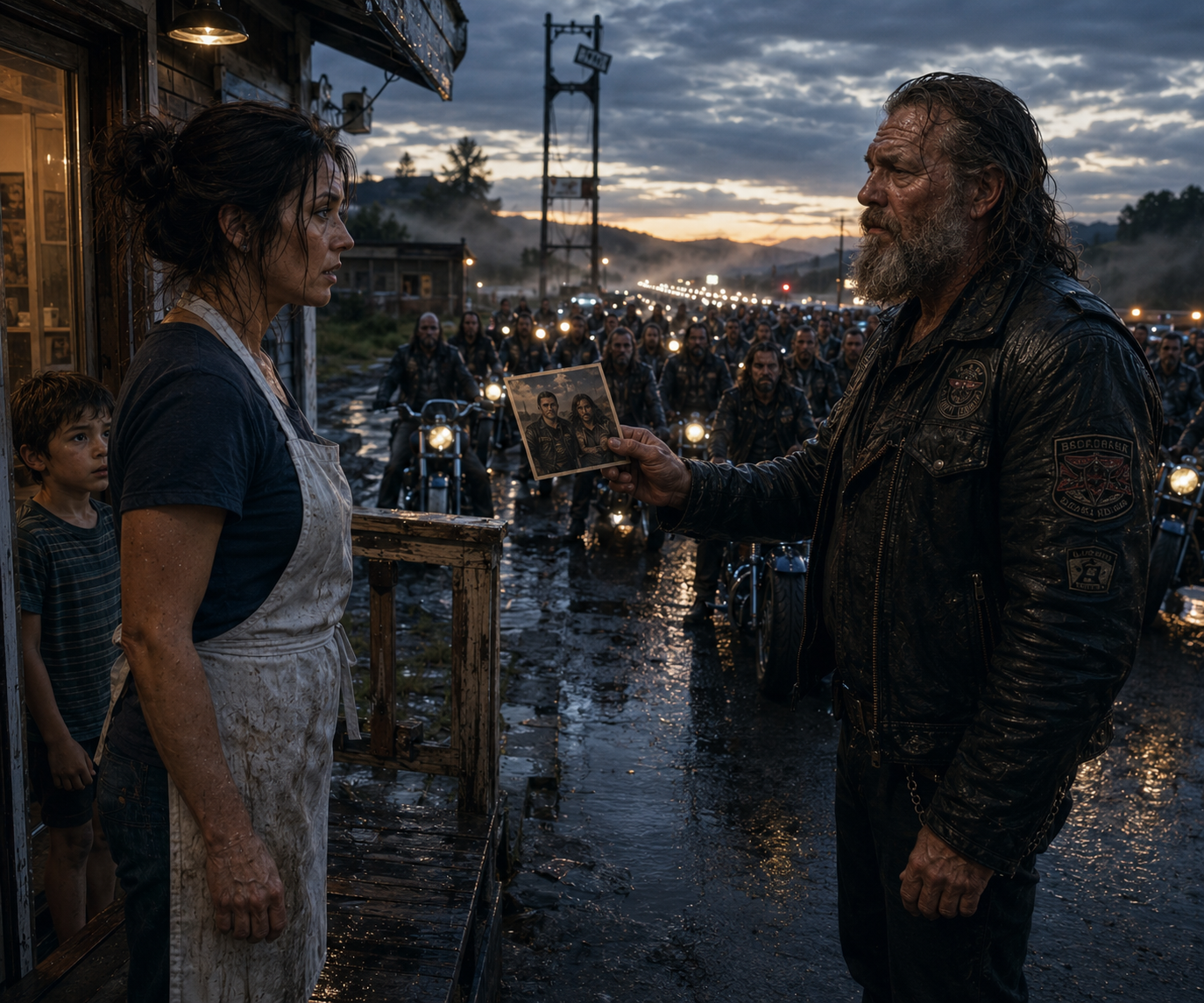
Dutch reached into his jacket.
He pulled out a folded photograph.
Then he handed it to her.
Sarah opened it.
Her hands began shaking.
The photograph showed a younger man standing beside Dutch.
Her father.
Sarah’s breath caught.
“My dad.”
Dutch nodded.
“He told us something before he died.”
Sarah stared at the photograph.
“When?”
“Twenty years ago.”
She looked up.
“What did he tell you?”
Dutch’s voice became quiet.
“He said, ‘If my daughter ever needs help, don’t wait for her to ask.’”
Sarah couldn’t speak.
She looked toward the enormous crowd.
Eight hundred bikers.
Standing silently.
Waiting.
Dutch turned toward them.
“Brothers.”
Eight hundred voices answered.
“Yeah?”
Dutch pointed toward Sarah’s diner.
“She fed twelve of us when she had almost nothing left.”
The crowd remained silent.
“She didn’t ask who we were.”
“She didn’t ask where we came from.”
“She didn’t ask whether we could pay.”
“She just fed us.”
Dutch looked at Sarah.
“She gave us what she had.”
Then he raised his voice.
“So today, we give her what we have.”
The crowd erupted.
Engines roared.
Men shouted.
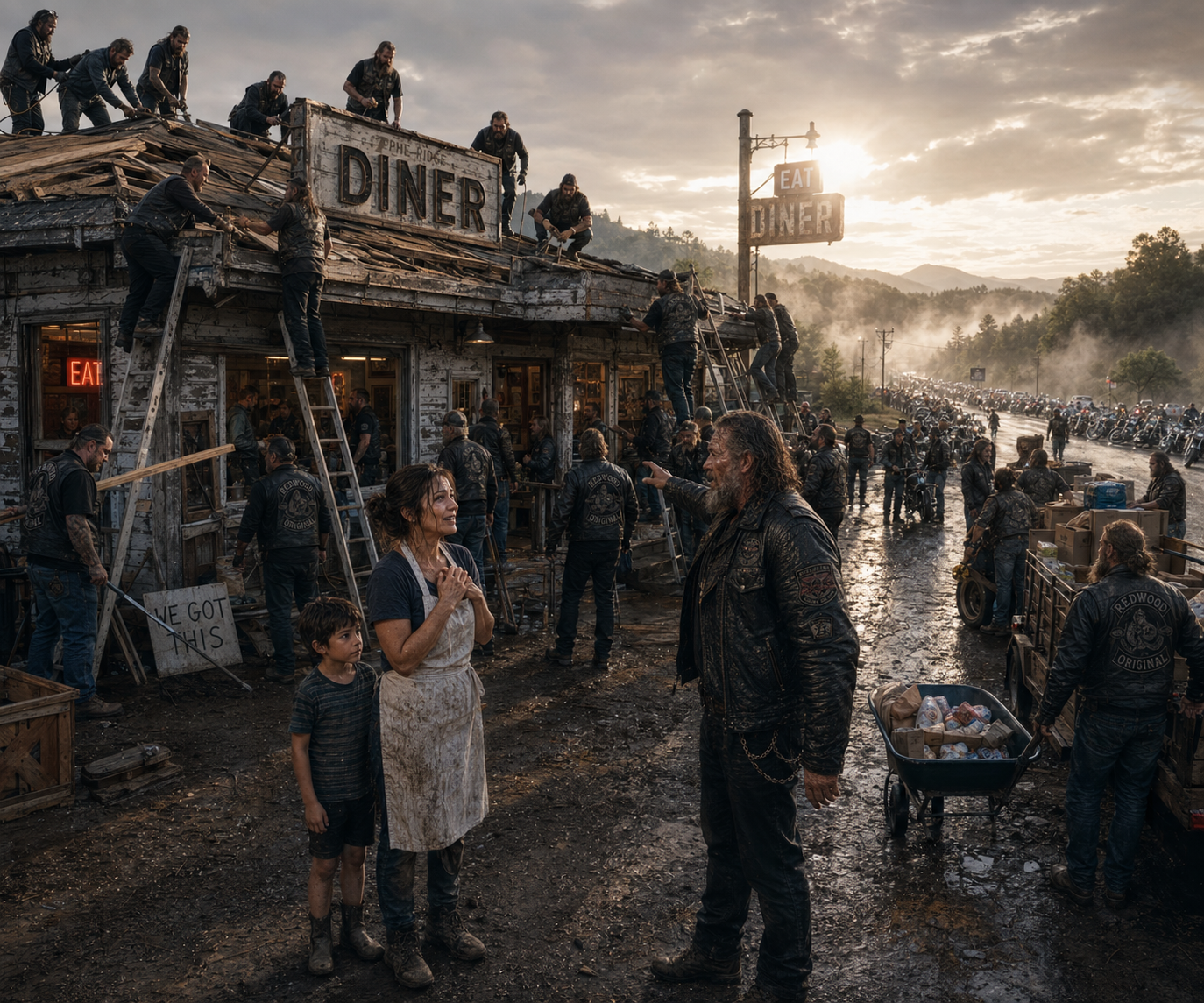
Tools appeared.
Pickup trucks rolled forward.
Within minutes, the parking lot looked like a construction site.
Sarah stood frozen.
“What are you doing?”
Dutch smiled.
“Fixing your diner.”
A biker carrying a toolbox walked past her.
Another carried lumber.
Three men climbed onto the roof.
Someone opened the hood of her dying refrigerator.
A mechanic crawled underneath it.
Another man inspected the electrical system.
Sarah grabbed Dutch’s arm.
“Wait.”
He stopped.
“This is too much.”
Dutch looked at her.
“You fed twelve men.”
“I had food.”
“You didn’t have enough.”
Sarah looked at the crowd.
“I still can’t let you do all this.”
Dutch shook his head.
“You already did.”
“What?”
“You already gave us permission.”
“I did?”
“The moment you fed us.”
Sarah stared at him.
Dutch smiled.
“You just didn’t know it.”
The work began.
By seven in the morning, the roof had been repaired.
By eight, the broken refrigerator was running again.
By nine, the electrical system had been fixed.
At ten, someone had replaced the diner sign.
At eleven, a crew had repainted the front entrance.
Sarah stood inside watching.
She didn’t know what to do.
For months, she had been trying to save the diner alone.
Now eight hundred strangers were doing in four hours what she couldn’t do in four months.
Ben wandered into the dining room.
He stared at the bikers.
“Mom?”
“Yes?”
“Are they all fixing our house?”
Sarah smiled.
“It’s a diner.”
Ben thought about that.
“Same thing.”
Sarah laughed.
One biker overheard him.
“Smart kid.”
Ben walked closer.
“Are you a biker?”
The man nodded.
“What’s your name?”
“Mike.”
“Do you have a motorcycle?”
Mike pointed outside.
“Three.”
Ben’s eyes widened.
“You have three?”
Mike nodded proudly.
“I have a bicycle.”
Mike crouched.
“That’s where it starts.”
Ben smiled.
By noon, the diner had transformed.
The roof no longer leaked.
The kitchen had been repaired.
The freezer worked.
The walls were painted.
The booths were repaired.
The front windows were replaced.
Someone had even fixed the old jukebox.
Sarah walked through the diner in disbelief.
She touched the new counter.
“This can’t be real.”
Dutch stood behind her.
“It is.”
“How much is this costing?”
“Nothing.”
“Nothing?”
“Somebody always pays.”
Sarah looked at him.
“Who?”
Dutch smiled.
“Everybody.”
Then he handed her a folder.
She opened it.
Inside were receipts.
Construction materials.
New equipment.
Electrical work.
Roofing.
Plumbing.
Food supplies.
The total was more than Sarah could imagine.
She looked at Dutch.
“I can’t repay this.”
He shook his head.
“That’s the point.”
“What do you mean?”
“You don’t repay kindness.”
“You pass it on.”
Sarah stared at him.
He continued.
“My father told me that.”
She looked at the photograph.
“Your father?”
Dutch nodded.
“He was one of the first men in our club.”
Sarah frowned.
“My father was a biker?”
Dutch laughed.
“You didn’t know?”
Sarah shook her head.
“My father owned a diner.”
“He did.”
“And he rode motorcycles?”
“Every weekend.”
Sarah stared at him.
“I had no idea.”
Dutch smiled.
“Your father didn’t tell many people.”
“Why?”
“Because he didn’t want you to worry.”
Sarah looked at the photograph again.
“What was his name?”
“Thomas.”
She nodded.
“That’s right.”
Dutch touched the photograph.
“Thomas saved my life.”
Sarah looked up.
“How?”
“Twenty-three years ago.”
Dutch paused.
“I was nineteen.”
“I thought I knew everything.”
“I rode too fast.”
“I crashed.”
“Your father found me.”
“He stayed with me until the ambulance arrived.”
Sarah listened.
“He could have left.”
“But he didn’t.”
“He told me something.”
“What?”
“‘If you ever become successful, remember the people who helped you when you were nothing.’”
Dutch smiled.
“I never forgot.”
Sarah looked around at eight hundred bikers.
“You brought all of them?”
Dutch nodded.
“Every chapter.”
Sarah laughed through tears.
“For one meal?”
“No.”
Dutch looked at her.
“For one man.”
He tapped the photograph.
“Your father.”
The story of Sarah’s father spread through the club that afternoon.
Bikers who had never met him listened.
Some had heard his name.
Others had only heard Dutch’s stories.
But they all understood what he had done.
He had helped someone when nobody else stopped.
Now his daughter was in trouble.
And the club had a rule.
They took care of their own.
Even if their own didn’t know they were part of the family.
By sunset, the diner was almost unrecognizable.
Sarah stood outside.
The old sign had been replaced.
It now read:
THOMAS’S ROADHOUSE
Sarah stared at it.
“Why did you do that?”
Dutch stood beside her.
“He would have liked it.”
Sarah shook her head.
“I don’t know if I can run a place with his name.”
“You can.”
“I’ve been failing.”
“No.”
She looked at him.
“You’ve been surviving.”
There was a difference.
Sarah looked toward the highway.
“I’m tired.”
“I know.”
“I almost gave up.”
“I know.”
“I was going to close next month.”
Dutch nodded.
“You don’t have to.”
Sarah looked at him.
“Why?”
“Because tomorrow morning, trucks are coming.”
“What trucks?”
“Food.”
She stared.
“How much?”
“Enough.”
“For how long?”
Dutch smiled.
“A while.”
Sarah laughed.
“You planned everything.”
“No.”
He looked at the crowd.
“They did.”
That night, the eight hundred bikers stayed.
They didn’t demand anything.
They didn’t drink.
They didn’t cause trouble.
They simply sat around the diner.
Some talked.
Some played cards.
Some repaired motorcycles.
Others told stories about Sarah’s father.
Sarah listened.
She learned things she had never known.
Her father had once ridden across three states to deliver medicine to a sick child.
He had helped a stranded family during a blizzard.
He had paid a stranger’s hospital bill.
He had repaired a motorcycle for free.
He had once slept in his truck so he could give his hotel room to a homeless veteran.
Sarah sat at a table listening.
“Why didn’t he ever tell me?”
An older biker named Ray answered.
“Because men like your father don’t keep score.”
Sarah looked down.
“I thought he was just my dad.”
Ray smiled.
“He was that too.”
At midnight, the bikers began leaving.
One by one.
Two by two.
Soon the enormous crowd became smaller.
Then smaller.
Finally, only Dutch remained.
Sarah stood beside him.
“Thank you.”
Dutch nodded.
“Don’t thank me.”
“Why?”
“Thank your father.”
Sarah smiled.
“I will.”
Dutch handed her a small envelope.
“What is this?”
“Open it later.”
He walked toward his motorcycle.
Sarah watched him.
“Dutch?”
He turned.
“What?”
“If my father was so important to you…”
She hesitated.
“Why did you wait so long?”
Dutch looked at the diner.
“Because he made me promise something.”
“What?”
“Never interfere unless you were needed.”
Sarah frowned.
“And now?”
Dutch smiled.
“Now you were.”
He put on his helmet.
The engine started.
Then he stopped.
“Oh.”
Sarah looked at him.
“What?”
Dutch pointed toward the kitchen.
“You still have my number.”
Sarah smiled.
“I don’t think I ever had it.”
“You do now.”
He disappeared down the road.
Sarah went inside.
Ben was asleep at the counter.
She carried him into the office.
Then she returned to the dining room.
She sat alone.
She opened the envelope.
Inside was an old handwritten note.
She recognized the handwriting immediately.
Her father’s.
Her hands trembled.
The note was short.
Sarah,
If you’re reading this, Dutch finally found you.
She stopped.
Tears filled her eyes.
I don’t know when you’ll need him.
Maybe you never will.
But I know one thing.
People are not measured by what they own.
They’re measured by what they do when they have little left to give.
If you’re anything like me, you’ll try to handle everything yourself.
Don’t.
Let people help you.
And when you have enough again, help someone else.
That’s how it works.
Love, Dad.
Sarah pressed the note against her chest.
She cried quietly.
Not because she was sad.
Because for the first time in years, she didn’t feel alone.
The next morning, the diner opened at six.
Sarah expected maybe three customers.
Instead, trucks arrived.
Food deliveries.
Fresh produce.
Meat.
Eggs.
Bread.
Coffee.
A new refrigerator.
A commercial freezer.
Boxes of supplies.
A local mechanic arrived to service the kitchen equipment.
A plumber came to inspect the pipes.
An electrician checked the wiring.
Sarah stood at the door.
“Who sent you?”
The first delivery driver smiled.
“Dutch.”
Another truck arrived.
Then another.
By noon, the diner was full.
News had spread.
Not about the bikers.
About Sarah.
About the woman who had fed twelve stranded men with her last food.
Customers came from neighboring towns.
Truckers returned.
Old customers came back.
People who had never visited before stopped because they had heard the story.
Someone posted a photograph online.
Then another.
Then thousands.
Within days, the diner became known across the state.
People called it the place where the bikers came.
But Sarah didn’t care about the attention.
She cared about keeping the promise in her father’s note.
So she created a new rule.
If someone came in hungry and couldn’t pay, they ate.
No questions.
No shame.
No explanation.
On the wall behind the counter, she placed a wooden sign.
IF YOU’RE HUNGRY, SIT DOWN.
Underneath:
SOMEONE WILL TAKE CARE OF THE BILL.
Business changed.
The diner grew.
But Sarah refused to become wealthy from it.
Every month, a portion of the profits went to roadside emergency charities.
Another portion helped stranded travelers.
Another paid for meals at shelters.
And every winter, Sarah hosted a free dinner for truckers who couldn’t make it home.
The bikers returned often.
Not eight hundred every time.
Sometimes twelve.
Sometimes fifty.
Sometimes only Dutch.
But Sarah knew what they represented.
Family.
Years later, Ben would remember the morning the motorcycles filled the highway.
He would remember standing on the porch beside his mother.
He would remember the sound.
The headlights.
The endless line of bikers.
And he would remember asking his mother whether they were there to fix their house.
She had laughed and told him it was a diner.
Ben would grow up hearing stories about his grandfather.
About Dutch.
About the twelve strangers.
About the eight hundred brothers.
And when he was old enough to understand, Sarah would explain the most important part.
“They didn’t come because we owed them.”
Ben would ask, “Then why?”
“Because we helped them when we could.”
“And they helped us when they could.”
Ben would think about that.
“So that’s how kindness works?”
Sarah would smile.
“Sometimes.”
“What happens the other times?”
“You help anyway.”
Years passed.
The diner survived.
Not because the highway became busier.
Not because the bank forgave everything.
Not because some miracle check arrived.
It survived because people came.
And stayed.
The roadside diner became a landmark.
Motorcyclists called it home.
Truckers called it safe.
Families called it their favorite stop.
And above the door hung a photograph of Thomas Bennett.
Beside it was a photograph of the twelve bikers from that stormy night.
Below both photographs was a simple sentence:
HE FED TWELVE.
THEY BROUGHT EIGHT HUNDRED.
But Sarah always told people that wasn’t really the story.
The real story was much simpler.
A woman was tired.
A group of strangers was hungry.
She had almost nothing.
And she gave anyway.
She didn’t know who they were.
She didn’t know who their father was.
She didn’t know that somewhere beyond the rain were hundreds of people carrying memories of the same man she had called Dad.
She simply saw twelve human beings freezing outside her door.
So she opened it.
That was all.
One meal.
One decision.
One act of kindness.
And sometimes, that is enough to change everything.
One winter evening, almost ten years after that storm, Sarah stood outside the diner watching the sunset.
Ben was older now.
Seventeen.
He was working behind the counter.
The diner was full.
Motorcycles lined the parking lot.
Dutch sat in his usual booth.
His beard was almost completely white.
Sarah walked over.
“You want coffee?”
Dutch smiled.
“Always.”
She poured it.
He looked around.
“Your father would be proud.”
Sarah smiled.
“I think so.”
Dutch looked toward the wall.
The photograph of Thomas was still there.
“So would mine.”
Sarah sat across from him.
“Do you still remember that night?”
Dutch laughed.
“Every detail.”
“The rain?”
“The rain.”
“The twelve men?”
“The twelve men.”
“The food?”
Dutch nodded.
“Best breakfast I ever had.”
Sarah smiled.
“You know, you never actually paid.”
Dutch grinned.
“I paid.”
“You did not.”
“Not that night.”
He pointed around the diner.
“This is payment.”
Sarah shook her head.
“You people are impossible.”
Dutch laughed.
Then his expression became serious.
“Sarah.”
“Yes?”
“I never told you the whole reason your father mattered to me.”
She looked at him.
“What else is there?”
Dutch reached into his vest.
He pulled out an old photograph.
The same one Sarah had seen years earlier.
But on the back was something she had never noticed.
A date.
And beneath it, several handwritten words.
REMEMBER THE GIRL.
Sarah stared.
“What does that mean?”
Dutch looked at her.
“Your father told me something else that day.”
“What?”
“He said, ‘If my daughter ever needs you, don’t let her become so proud that she refuses help.’”
Sarah laughed.
“That sounds like him.”
Dutch nodded.
“He knew you.”
Sarah looked at the photograph.
“I wish I had listened to him more.”
“You are now.”
“How?”
She looked around the diner.
Dutch smiled.
“You’re helping people.”
Sarah looked toward the front door.
A young couple had just walked in.
They looked exhausted.
The man was carrying a sleeping child.
Sarah stood.
“Welcome.”
The woman hesitated.
“Can we get some food?”
Sarah smiled.
“Of course.”
“We don’t have much money.”
Sarah shook her head.
“Sit down.”
The woman looked surprised.
Sarah repeated the words she had spoken years earlier.
“Did I ask you for a wallet?”
The woman smiled.
“No.”
“Then sit.”
Sarah walked into the kitchen.
She turned on the grill.
Eggs hit the hot surface.
Bacon began sizzling.
Bread went into the toaster.
Outside, motorcycles continued arriving.
One.
Then another.
Then another.
Sarah looked through the window.
Dutch was smiling.
He knew what was happening.
The legacy was continuing.
Not because eight hundred bikers were protecting a diner.
Not because one woman had been rescued.
But because one night, twelve strangers had been hungry.
And one woman had decided that whatever she had, she could share.
At dawn, hundreds had come to repay her.
But the greatest thing they gave her wasn’t a new roof.
It wasn’t a working refrigerator.
It wasn’t money.
They gave her back something she had almost lost.
Hope.
And from that day forward, Sarah understood what her father had tried to teach her.
Kindness is not a transaction.
You don’t give because you expect something in return.
You give because someone needs it.
And sometimes, years later, when you least expect it, someone else will open a door for you.
Maybe it will be twelve bikers.
Maybe eight hundred.
Maybe only one stranger.
You never know.
But you keep giving anyway.
Because somewhere on some dark road, someone may be freezing.
Someone may be hungry.
Someone may be scared.
And all they may need is one person willing to say:
“Sit down.”
“I’ve got you.”
Sarah looked at the old photograph of her father one final time.
Then she turned toward the kitchen.
The diner was full.
The coffee was hot.
The grill was burning.
And outside, motorcycles lined the highway beneath the morning sun.
The woman who once believed she was losing everything had discovered something far more valuable than money.
She had inherited a family she never knew she had.
Twelve hungry strangers had walked into her diner during a storm.
Eight hundred brothers had returned at dawn.
And one simple meal had become a legacy that would last for generations.
Because sometimes kindness doesn’t come back as a thank-you.
Sometimes it comes back as a hand on your shoulder.
A repaired roof.
A full refrigerator.
A crowded dining room.
A photograph of someone you loved.
And sometimes…
Sometimes it comes back as an army of eight hundred bikers standing outside your door at sunrise, reminding you that you were never alone.