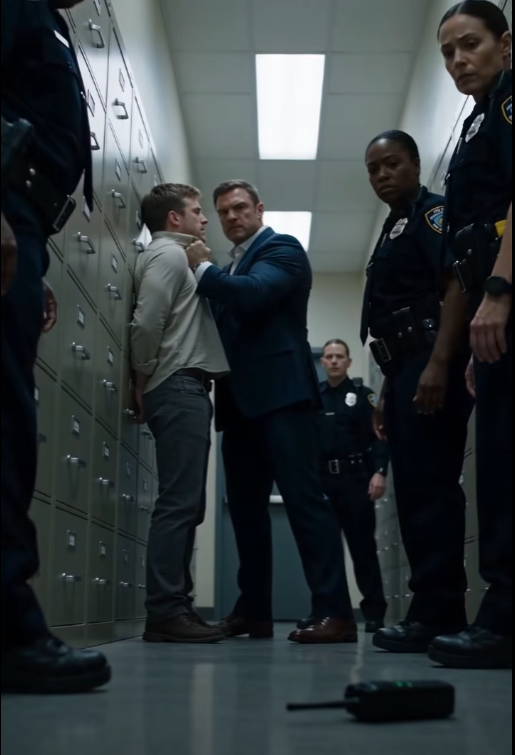
For the first time in years, nobody asked me to repeat myself.
The room remained completely silent.
Not the ordinary silence of people waiting for someone to finish speaking.
This was different.
It was the silence of people who had just heard something they could no longer explain away.
The recording continued through the hearing device.
The officer’s voice came through the small speaker, distorted only slightly by the device’s tiny output.
“If you keep complaining, you’ll lose your home.”
Then came another voice.
A woman.
Quiet.
Frightened.
“He told her that before.”
The timestamp appeared on the hearing device’s display.
11:43 p.m.
The same night I had reported.
The committee chair leaned forward.
“Where did that recording come from?”
I looked at her.
“From my hearing device.”
She stared at me.
“You recorded the conversation?”
“I didn’t know I was recording it.”
The officer suddenly stepped backward.
“That doesn’t prove anything.”
Nobody looked at him.
The chair raised one hand.
“Officer Harris, please remain silent.”
He opened his mouth.
She raised her hand again.
“Please.”
He closed it.
I looked down at my notebook.
My hands were shaking.
Not because I was afraid of him anymore.
Because I was finally hearing something I had waited years to hear.
Silence from everyone who had once doubted me.
THE RECORDING
The committee technician asked me to remove the hearing device carefully.
I hesitated.
The device was old.
Small.
Scratched.
It had been with me for years.
People had laughed at it.
People had told me it malfunctioned.
People had used it as proof that I couldn’t trust what I heard.
And now everyone in that room wanted to know what it remembered.
I removed it and placed it on the table.
The technician connected it to a computer.
Within seconds, the room filled with the sound of the past.
My apartment door opening.
Footsteps.
Three men entering.
One of them was Officer Harris.
Another was a man I didn’t recognize immediately.
The third voice was unmistakable.
A building supervisor who had denied being there that night.
The recording played without interruption.
“You need to understand something,” Harris said.
Then my younger voice answered.
“I already explained everything.”
“You keep filing complaints.”
“Because nobody is doing anything.”
A chair scraped across the floor.
Then Harris spoke.
“You’re making this harder than it needs to be.”
I remembered that moment.
I remembered sitting at my kitchen table.
I remembered the fear.
I remembered gripping my phone.
I remembered trying to understand why three men had entered my apartment without permission.
The recording continued.
“Give me the phone.”
“No.”
“Give me the phone.”
“I have the right to keep it.”
A pause.
Then the sentence that had followed me for years.
“If you keep complaining, you’ll lose your home.”
The hearing room went silent again.
The technician paused the recording.
Nobody moved.
The chair looked at me.
“Is that what you remember?”
“Yes.”
“Exactly?”
“Yes.”
She looked at Officer Harris.
“Is that your voice?”
Harris didn’t answer.
“Officer Harris.”
His face was pale.
“It sounds like me.”
The chair’s expression hardened.
“That’s not what I asked.”
He swallowed.
“Yes.”
The word was barely audible.
But it was enough.
THE WOMAN IN THE RECORDING
The technician resumed playback.
The second voice appeared.
A woman.
“I don’t think you should take her phone.”
Harris answered.
“You weren’t asked.”
“I saw what happened.”
“You saw nothing.”
“I was standing right there.”
A chair moved.
Someone walked across the room.
Then Harris said something that made the entire committee freeze.
“Then forget what you saw.”
The woman answered:
“I can’t.”
Harris laughed.
“You’d be surprised what people forget.”
The recording stopped.
The chair looked at me.
“Do you know who that woman is?”
I shook my head.
“No.”
Harris suddenly spoke.
“She was never there.”
The chair turned toward him.
“You just admitted you knew her.”
He stopped.
The technician looked at the committee.
“We can enhance the audio if necessary, but the original recording is clear enough for identification.”
The chair nodded.
“Find her.”
Harris stood.
“This is ridiculous.”
Two security officers moved toward him.
He looked at them.
Then at the committee.
“You’re going to destroy my career over a damaged hearing device?”
I stared at him.
He looked at me.
“You’ve always misunderstood things.”
That sentence brought back years of memories.
Doctors.
Landlords.
Officials.
Neighbors.
People speaking slowly to me as though I were a child.
People smiling sympathetically while deciding I couldn’t possibly understand what was happening.
Every time I complained, someone asked if I was sure.
Every time I described a conversation, someone asked whether I had heard it correctly.
Every time I said someone had threatened me, they asked whether I might have misunderstood the tone.
But I had never misunderstood the threat.
And now it was sitting on a computer in front of everyone.

THE SECOND FILE
The technician suddenly stopped.
“There is another recording.”
The chair looked up.
“Another?”
“Yes.”
He opened a second file.
The timestamp was from three days before the hearing.
My stomach tightened.
I didn’t remember making it.
The technician pressed play.
At first, there was only background noise.
Then voices.
Officer Harris.
And someone else.
A man.
“You’re sure she still has it?”
Harris answered.
“She doesn’t know.”
“Then why hasn’t she withdrawn the complaint?”
“She doesn’t trust me.”
A short silence.
“Then make her trust you.”
“How?”
“Pressure.”
My heart began beating faster.
The committee chair leaned closer to the speakers.
The conversation continued.
“She’ll lose the apartment if the landlord follows through.”
“She knows that?”
“She knows enough.”
“And the device?”
Harris laughed.
“She thinks it’s unreliable.”
The room went still.
I felt cold.
For years, I had believed my hearing device was failing me.
I had blamed the static.
The interruptions.
The strange gaps.
The occasional distortion.
But now I understood.
They had known about it.
They had known it could record.
They had counted on me believing it couldn’t.
The recording continued.
Harris said:
“She won’t use it.”
The other man replied:
“Good.”
Then came the words that changed everything.
“People believe what they’re told about people like her.”
The technician stopped the recording.
Nobody spoke.
I looked at the chair.
She looked back at me.
Then she asked quietly:
“How long have you had this device?”
“Seven years.”
“And how long have you been told it was unreliable?”
“Almost that long.”
The technician shook his head.
“There’s nothing wrong with the recording system.”
He looked at the device.
“Whoever programmed this knew exactly what they were doing.”
THE WITNESS
The committee adjourned for twenty minutes.
I remained seated.
My hands were still trembling.
A security officer approached me.
“Are you all right?”
I nodded.
“Yes.”
He looked uncomfortable.
“I’m sorry.”
“For what?”
He hesitated.
“For what happened to you.”
I looked around the room.
“It’s not over.”
He nodded.
“I know.”
When the hearing resumed, the chair announced that a witness had been located.
The woman from the recording.
She entered slowly.
She was older than I remembered.
But I had never actually seen her before.
She had been in my apartment that night.
She had stood behind Harris.
She had heard everything.
And she had been silent for years.
She sat at the witness table.
The chair asked her to identify herself.
She did.
Then she looked at me.
“I am sorry.”
I didn’t know what to say.
The chair asked:
“Were you present at the complainant’s apartment on the night in question?”
“Yes.”
“Why did you deny being there?”
The woman looked down.
“Because I was afraid.”
“Of Officer Harris?”
“Yes.”
“Did he threaten you?”
“Yes.”
“What did he say?”
She took a breath.
“He told me that if I supported her complaint, I would lose my job.”
The chair nodded.
“Did you believe him?”
“Yes.”
“Why?”
The woman looked toward Harris.
“Because he had already done it to someone else.”
The room changed.
The chair leaned forward.
“Explain.”
The witness swallowed.
“There was another tenant.”
She looked at me.
“He complained before she did.”
“What happened?”
“He was evicted.”
My chest tightened.
“On what grounds?”
“Violation of building rules.”
I stared at her.
“Was that true?”
“No.”
The word was quiet.
But devastating.
THE PATTERN
The investigation expanded.
What had started as one complaint became a pattern.
Five tenants.
Seven complaints.
Three witnesses.
Two missing security recordings.
One unauthorized search.
Multiple threats.
And every time someone complained, the same explanation appeared in the paperwork.
Misunderstanding.
Miscommunication.
Insufficient evidence.
Unreliable memory.
The committee began reviewing old cases.
They found something else.
Every complaint involving Officer Harris had been reviewed by the same internal supervisor.
And every complaint had been dismissed.
The supervisor’s name appeared repeatedly.
I recognized it.
It was the name of the man whose voice had appeared in the second recording.
The man who had told Harris to pressure me.
The man who had said:
“People believe what they’re told about people like her.”
The investigation now had two levels.
Harris had threatened me.
His supervisor had protected him.
And someone above them had allowed the system to continue.
For years.
The hearing stopped being about whether I had heard correctly.
It became a question of how many people had benefited from pretending I hadn’t.

THE ATTACK ON MY CREDIBILITY
Harris’s attorney tried to fight back.
He argued that the recordings had been obtained without consent.
He argued that the hearing device was not intended to function as a recording device.
He argued that I had misunderstood the conversations.
He argued that the files could have been altered.
Then he said something that made the room uncomfortable.
“My client believes the complainant’s memory has been compromised by her dependence on a hearing device.”
I looked at him.
There it was.
The same old weapon.
Not evidence.
Not facts.
Doubt.
They couldn’t destroy the recording.
So they tried to destroy the person who made it.
The chair didn’t react immediately.
She looked at me.
“Would you like to respond?”
I stood.
My legs were shaking.
But my voice was steady.
“Yes.”
I looked at Harris.
Then his attorney.
Then the committee.
“For years, you told me I couldn’t trust what I heard.”
I touched the hearing device on the table.
“You told me this device was unreliable.”
I took a breath.
“You told me my memory was unreliable.”
I looked at the recording equipment.
“But nobody ever asked why I remembered the same things every single time.”
The room was silent.
“I didn’t need perfect hearing to know someone threatened me.”
I pointed toward the device.
“And I didn’t need perfect hearing to know what I heard that night.”
I paused.
“You were right about one thing.”
Harris’s attorney looked at me.
“My hearing device was not perfect.”
I looked down at it.
“But it was honest.”
THE FILE THEY DIDN’T EXPECT
The technician raised his hand.
“There is one more file.”
The chair frowned.
“From when?”
“Three years ago.”
My heart stopped.
“Can you play it?”
“Yes.”
The recording began.
It was an earlier meeting.
A private meeting.
I recognized my own voice.
I sounded younger.
More frightened.
“I just want someone to listen.”
Then a man’s voice.
The internal supervisor.
“You need to stop filing complaints.”
“I won’t.”
“You’re making this difficult.”
“I have proof.”
A pause.
“What proof?”
“I wrote everything down.”
The supervisor laughed.
“Your notes don’t matter.”
Then another voice.
Harris.
“She won’t stop.”
The supervisor answered.
“Then make sure nobody listens to her.”
The recording ended.
The committee members stared at one another.
Three years.
They had known.
Three years before the hearing.
Three years before the apartment incident.
Three years before I finally placed my hearing device on the table.
They had been trying to silence me long before I understood what they were doing.
THE DECISION
The hearing lasted six hours.
By the end, the committee issued an emergency finding.
Officer Harris was suspended immediately.
His supervisor was removed from his position pending criminal investigation.
The unauthorized search was referred for prosecution.
The eviction records were reopened.
The previous complaints were ordered to be independently reviewed.
And my original complaint was officially recognized as credible.
But the chair said something else.
Something I had not expected.
“This committee failed you.”
I looked up.
She continued.
“We relied on records that should have been questioned.”
She paused.
“We accepted explanations without investigating the pattern.”
Her voice softened.
“And we allowed assumptions about your hearing disability to become a substitute for evidence.”
Nobody moved.
She looked directly at me.
“That should never have happened.”
I lowered my eyes.
For years, I had imagined what it would feel like to be believed.
I thought it would feel like victory.
It didn’t.
It felt like exhaustion.
Because being believed after years of being doubted doesn’t erase the years you spent fighting to be heard.
It simply proves that you should never have had to fight that hard in the first place.

AFTER THE HEARING
Outside the building, reporters waited.
Microphones appeared.
Questions came from every direction.
“Did you know the device was recording?”
“No.”
“Do you think Officer Harris should go to prison?”
“That is not my decision.”
“Do you consider yourself a whistleblower?”
I shook my head.
“No.”
“Then what are you?”
I looked at the hearing device in my hand.
“A person who refused to forget.”
That answer appeared in newspapers the next morning.
People began sharing my story.
Other former tenants came forward.
More recordings appeared.
More complaints.
More names.
The investigation grew.
Within months, the case involved dozens of people.
Some had been threatened.
Some had been pressured.
Some had lost their homes.
Some had lost their jobs.
And many had stopped complaining because they believed nobody would listen.
I understood them.
I had almost stopped too.
But one thing kept me going.
That tiny device.
The thing everyone told me was unreliable.
The thing that had been treated as evidence of my weakness.
It had become evidence of the truth.
THE LAST CONVERSATION
A year later, I returned to the hearing room.
It was empty.
The chairs were still arranged around the long table.
The microphones were still there.
The same wooden walls surrounded the room.
I sat alone.
I placed my hearing device on the table.
For a moment, I simply looked at it.
Then the chair entered.
She smiled when she saw me.
“I didn’t expect you back.”
“I wanted to see the room.”
She sat across from me.
“Why?”
I thought about that.
“Because I was afraid of it for a long time.”
She nodded.
“And now?”
“Now it is just a room.”
She smiled.
“I suppose that’s progress.”
I picked up the device.
“Can I ask you something?”
“Of course.”
“Why did you believe me that day?”
She looked at the device.
“Because the evidence was clear.”
I shook my head.
“No.”
She waited.
“You believed me because you finally listened.”
She didn’t answer.
I continued.
“That’s different.”
She nodded slowly.
“Yes.”
WHAT THE DEVICE REMEMBERED
That evening, I returned home.
My apartment was quiet.
The same apartment where the men had entered years earlier.
The same kitchen.
The same table.
The same door.
But it no longer felt like a place where I had been threatened.
It felt like my home again.
I sat down.
I removed the hearing device.
Then I held it in my hand.
Seven years.
It had been with me through every appointment.
Every complaint.
Every argument.
Every accusation that I couldn’t remember correctly.
People had looked at it and seen a disability.
I had looked at it and seen a tool.
Now I understood something else.
The device had never been the reason people doubted me.
They doubted me because believing me would have required them to question people with authority.
That was harder.
So they chose the easier explanation.
She misunderstood.
She misheard.
She forgot.
She imagined it.
But the truth doesn’t become less true because someone refuses to listen.
And memory doesn’t become false because someone finds it inconvenient.
I turned the device over in my hand.
There was a tiny scratch along the side.
I remembered when I got it.
The technician had told me:
“It’s not perfect.”
He had been right.
It wasn’t.
But neither were people.
Neither were reports.
Neither were officials.
Neither were institutions.
The difference was that my device never pretended to remember everything.
It only remembered what it captured.
And what it captured was enough.
THE FINAL TESTIMONY
Months later, I was invited to speak at a training session for public officials.
I almost refused.
Then I accepted.
I stood in front of a room filled with people whose jobs depended on listening to complaints.
I placed the hearing device on the table.
I told them the story.
Not dramatically.
Not angrily.
Just honestly.
When I finished, one young officer raised his hand.
“What should we have done differently?”
I thought about the question.
Then I answered.
“You should have listened before deciding.”
He nodded.
I continued.
“Don’t begin with the question, ‘Can we prove her wrong?’”
The room was silent.
“Begin with, ‘What if she’s telling the truth?’”
Someone wrote that down.
I looked around the room.
“And if you don’t know whether someone heard correctly, don’t punish them for asking to be heard.”
I picked up the device.
“This was once used as an excuse to doubt me.”
I held it up.
“Then it became evidence.”
I paused.
“But the device wasn’t the hero.”
I looked directly at the young officer.
“The people who listened were.”
YEARS LATER
I still use the same hearing device.
The casing is more scratched now.
The battery has been replaced many times.
The recording system no longer works as well as it once did.
Eventually, I will need a new one.
But I don’t think I’ll ever throw this one away.
Not because it is valuable.
Because it reminds me.
It reminds me that there was a time when I walked into a room and nobody believed me.
A time when an officer stood over me and told me I would lose my home.
A time when someone reached for the device behind my ear because he believed taking it away would take away my voice.
He was wrong.
My voice was never inside the device.
It was inside me.
The device simply helped other people hear it.
And when the truth finally came out, it wasn’t loud.
It didn’t arrive with a dramatic confession.
It came through a tiny speaker.
A few words.
A timestamp.
A frightened witness.
And a recording that refused to disappear.
I often think about that first sentence.
“If you keep complaining, you’ll lose your home.”
For years, I believed those words were a threat.
Now I hear them differently.
They were a confession.
Because they revealed exactly what they were afraid of.
Not my hearing.
Not my memory.
Not my complaints.
The truth.
They were afraid that if I kept speaking, eventually someone would listen.
And they were right.
I kept speaking.
Someone listened.
Then someone else.
Then another.
Until the room that had once been built to silence me became the room where the truth was finally recorded.
I picked up my hearing device one last time.
Placed it behind my ear.
The world became clear.
Not perfect.
Never perfect.
But clear enough.
I could hear the clock.
The traffic outside.
The soft hum of the refrigerator.
My own breathing.
And somewhere beyond the apartment, I heard a door close.
For a moment, I remembered that night.
The footsteps.
The voices.
The threat.
The fear.
Then I remembered something else.
The hearing room.
The recording.
The silence after the truth was played.
And the moment nobody asked me to repeat myself.
I smiled.
Because I finally understood what had happened.
They had spent years telling me that I couldn’t hear the truth.
But the truth had been there the entire time.
Waiting.
Remembering.
Recording.
And when they finally tried to silence me one last time, my hearing device spoke for me.
Not because it was perfect.
Not because it was powerful.
But because someone had finally given the truth a chance to be heard.
And once the truth is heard—
it becomes very difficult to silence again.
I had spent years being told that I didn’t hear things correctly.
But I remembered.
I always remembered.
And now—
so did everyone else.